The much-awaited revival of Saburo Teshigawara’s 2022 production of Gluck’s Orfeo ed Euridice, seen on December 6, truly embodied the spirit of “less is sometimes more.”
First presented in Vienna in 1762, Gluck’s Orfeo ed Euridice is famously the “reform opera” that strips away Baroque ornamentation to focus on raw human drama. The opera relates the ancient Greek myth of Orpheus, the master musician, whose overwhelming grief following the death of his bride, Eurydice, compels him to descend into the Underworld. His lyre-playing charm wins over the Furies, permitting him to lead Eurydice back to the world of the living—on the single condition that he not look upon her until they reach the light. His inevitable failure leads to Eurydice’s second, final death. However, in Gluck’s Italian version, the tragedy is transformed: Amore (Cupid) intervenes, moved by Orpheus’s despair, and restores Eurydice to life, culminating in a general celebration of devoted love.
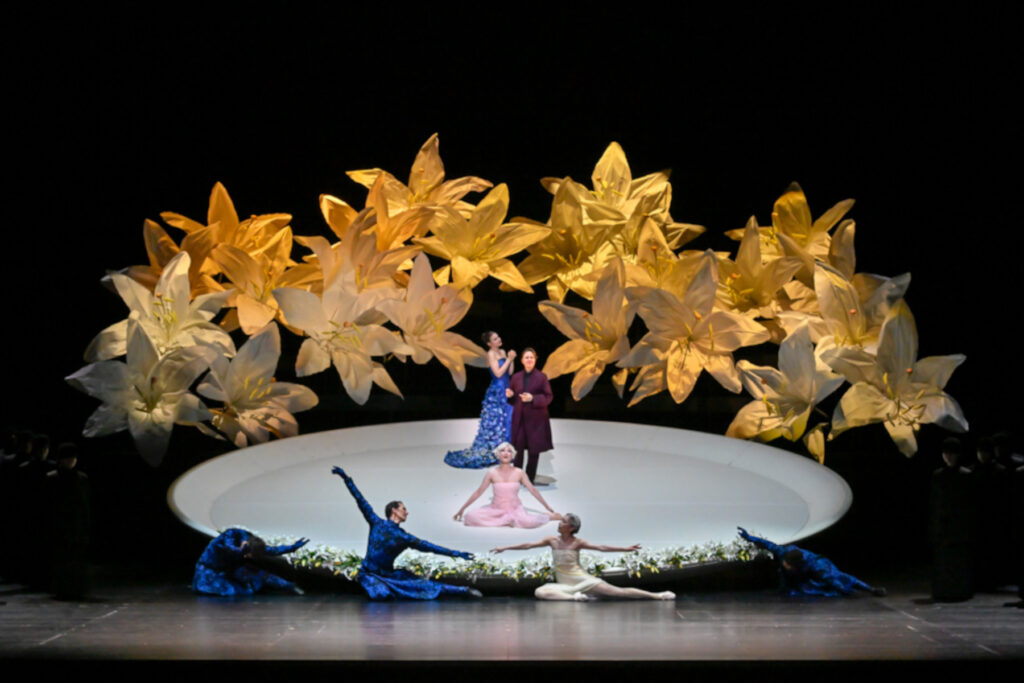
Teshigawara’s production brings this resolution to the fore with an unwavering, stripped-down beauty, achieved through a dramatically evolving set. In Act I, the stage is dominated by an 8-metre circular platform created in the image of a flower arrangement plate, sloping towards the audience, upon which Orfeo performs his lamentations while the sombre chorus, clad in dark-grey manteaux, sings below. The fair-haired Amore appears to announce that Jove, moved to pity, will allow Orfeo to descend. In Act II, the entrance to the Underworld is symbolised by a wall of withered flowers, through which Orfeo is finally allowed to pass. The scene then transforms with breathtaking speed and beauty: huge white lilies, symbolic of purity, emerge dramatically from the background in a way that recalls the striking scenic changes of Kabuki theatre. This visual splendour is short-lived; the pure-white blossoms slowly turn to yellowish hues as the story unfolds. Act III sees a smaller version of the white lilies above the original plate. It is upon this simple, powerful stage that Orfeo and Eurydice—later joined by Amore—sing, infuriate, implore, despair, and finally find joy. This commitment to the purity of beauty proved entirely successful, laying the groundwork for a truly sublime experience.
The musical performance was, for the most part, superb. As Orfeo, the veteran Italian contralto Sara Mingardo was a noble husband and an accomplished musician. Her imposing stature and warm, rich, elegant alto make her an ideal fit for the role. Her lamentations, sung and performed wholeheartedly, were persuasive throughout. The only minor caveat was an occasional pitch discrepancy, where her tone sometimes sounded a shade higher than the accompanying modern orchestra. That aside, it was a splendid house debut, culminating in her magnificent rendition of “Che farò senza Eurydice” in Act III, which she delivered almost sotto voce against a minimal orchestral background. The young Italian soprano Benedetta Torre brought sparkle to the role of Euridice, also making a remarkable house debut. Her bright, clear soprano and slender figure, enhanced by a mermaid-shaped blue dress, perfectly embodied the young bride, suspicious of her husband’s seeming coldness. Her despair was dramatically expressed in her aria “Che fiero momento,” eliciting prompt and enthusiastic applause. Yuki Sugiyama’s beaming Amore was suitably playful, executing the character’s trills and ornamentations masterfully. In the pit, Ryuichiro Sonoda conducted the Tokyo Philharmonic Orchestra with order and light precision, and the New National Theatre Chorus gave a powerful and moving performance.
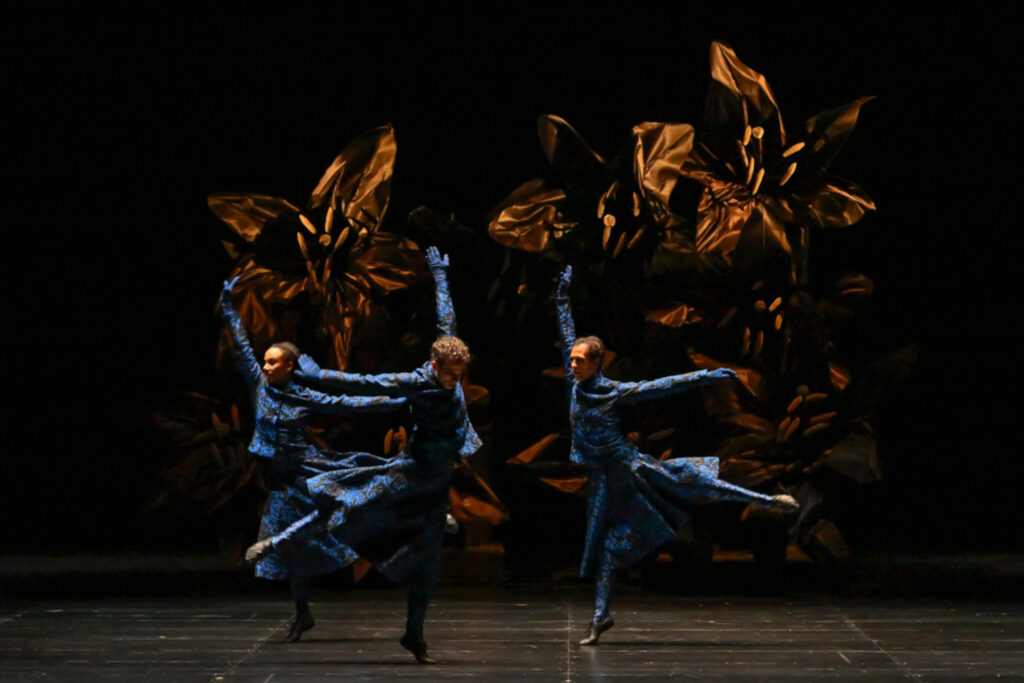
The superb vocal and orchestral performance was rivalled only by the realization of the choreographic vision delivered by four dancers. Orfeo descends into the Underworld and the Fields of Elysium, the realm where gravity-defying, silent spirits are dancing. World-renowned dancer and choreographer Teshigawara brilliantly realized these spirits through the vocabulary of contemporary dance, departing entirely from Baroque or Classical ballet. At times the four moved in perfect synchronicity, and at others, they were divided into striking configurations: one alone, one and three, or two and two. Rihoko Sato wore white, while Alexandre Riabko, Ophelia Young, and Javier Ara Sauco wore blue costumes. Their movements were entirely weightless—sometimes fluttering like butterflies, sometimes possessing dramatic expression within profound stillness.
Teshigawara wrote in his original production notes: “In an era that feels suffocating, is it not the abstraction of expression that is lacking? I believe that when those living now are confronted with difficult realities, the power generated by a rich abstraction is needed.” The masterful dancing in this Orfeo did more than just complement the opera’s story and music; it offered the audience a spiritual freedom—a space to appreciate the narrative and music while simultaneously wandering into a different, abstract world.
Natsuko Hirakura
Orfeo ed Euridice
Music: Christoph Willibald von Gluck
Libretto: Ranieri de’ Calzabigi
Cast and Production Staff:
Orfeo – Sara Mingardo; Euridice – Benedetta Torre; Amore – Sugiyama Yuki; Dance – Sato Rihoko, Alexandre Riabko, Ophelia Young, Javier Ara Sauco
Director, choreography, sets, costumes & lighting – Teshigawara Saburo; Artistic Collaborator – Sato Rihoko; Tokyo Philharmonic Orchestra and New National Theatre Chorus, Conductor – Sonoda Ryuichiro
New National Theatre Tokyo, 6 December 2025
All photos © Akihito Abe