The German-speaking Czech-born composer Viktor Ullmann (1898-1944) was active in the concentration camp at Terezín (Theresienstadt), at which the inmates were encouraged to give numerous musical performances. The Nazis developed this so-called model camp in order to deceive the international community about the concentration-camp system. Ullmann composed many pieces during his two years of imprisonment and hard labor at Terezín. He was eventually sent to his death at Auschwitz.
Many of Ullmann’s works were performed by the other inmates at the camp. His one-act opera Der Kaiser von Atlantis, oder Die Tod-Verweigerung (The Emperor of Atlantis, or Death’s Refusal [i.e., Disobedience]) went through several drafts, but the Nazis objected to its subject matter and satirical tone and therefore stopped it from getting performed. Fortunately, various manuscripts and typescripts of the libretto and score survive. As a result, the work has been performed by numerous opera houses and music-school opera programs, and there have been several recordings and at least one video (with Teresa Stratas and Siegmund Nimsgern).
The plot is fairy-tale-like, but not at all light-hearted: in critic Andrew Porter’s words, Emperor is an “elusive death-welcoming parable about a mad, murderous ruler, possibly redeemed at last, who says farewell to the world in a mock-Faustian vision of a natural paradise no longer spoiled by men.” The opera’s subtitle is “Death’s Refusal” because Death decides not to go along with the Emperor’s megalomaniacal schemes for a war of all against all. When the work was first performed (in the 1970s), the subtitle was changed, perhaps for clarity, to “Der Tod dankt ab”: “Death Abdicates.”
The characters are all symbolic types—none has a true name. Appropriately, in this recording, several singers play more than one role.
The musical style is lively and varied, including references to popular-dance rhythms and extended uses of the three familiar melodies: the Lutheran chorale “Komm süsser Tod” (“Come, sweet death”), the Haydn tune that was the German national anthem at the time, and the beloved German folk-lullaby “Schlaf’, Kindlein, schlaf’” (using the well-known version made by Schubert’s predecessor Johann Friedrich Reichardt; its standard words in English are “Sleep, Baby, Sleep”). I was reminded at various moments of Weill’s Mahagonny, Berg’s Wozzeck, and Jack’s Kingdom, a Czech opera by Otakar Ostrčil that I have likewise reviewed here. At times I also sensed a kinship to some early Hindemith pieces that likewise play with a wide range of styles, but Ullmann’s music here tends to shift styles more frequently and kaleidoscopically. Conductor Franco Agudin (from Buenos Aires, now active in both Argentina and Switzerland) ensures much vividness moment to moment.
The booklet-essay explains that the performance was based on a careful re-examination of all the sources. There is no indication, though, how much the results differ from those published in the critical edition by Henning Brauel and Andreas Krause, which Eulenburg published the same year that this recording was made (2015). Some passages of music and some stretches of words are different from those in other performances and recordings. Still, the overall effect is quite similar to what I remember from a live performance in Rochester NY and from the 1993 recording (still available, though perhaps only as a download or through streaming), which is conducted by Lothar Zagrosek. The accompanying ensemble uses Ullmann’s notated chamber orchestration, not (as Zagrosek’s does) an expanded version for full orchestra.
The current cast is less starry than Zagrosek’s, which featured Herbert Lippert, Walter Berry, Franz Mazura, and a breathtakingly wonderful Iris Vermillion. But the singers on the new recording (all new names to me; they come from a variety of European countries) sing well and interact effectively. (The present review was first published in American Record Guide in 2019: Since then, I have also reviewed another recording, from Munich. It is conducted by rising star Patrick Hahn. The singers are relatively young but, again, very effective, not least Tareq Nazmi—from Kuwait, who later trained in Munich—as Death.)
A special word should be said about Vasyl (spelled Wassyl in the booklet) Slipak. This marvelously intense bass-baritone, from Ukraine, gave up a promising operatic career in Paris to become part of a volunteer army fighting to put down pro-Russian forces in his native land. He was killed by a sniper’s bullet in 2016, a year after this recording was made. He was 41 years old. This CD release is dedicated to his memory. (A documentary film has been made in Ukraine about Slipak. Its title, Myth, refers to his nom de guerre Mif, which derived from the name of one of his favorite operatic characters, Gounod’s Méphistophélès.)
The recording contains excellent essays and the full libretto, all in four languages (German, French, Spanish, and English). Anybody who has wondered about this much-discussed work now has yet another way of becoming familiar with it and pondering its messages. I know no more thoughtful disquisition, for the opera stage, on basic questions of life, death, war, love, power, and resistance.
Ralph P. Locke
Ralph P. Locke is emeritus professor of musicology at the University of Rochester’s Eastman School of Music and Senior Editor of the Eastman Studies in Music book series (University of Rochester Press), which has published over 200 titles over the past thirty years. Six of his articles have won the ASCAP-Deems Taylor Award for excellence in writing about music. His most recent two books are Musical Exoticism: Images and Reflections and Music and the Exotic from the Renaissance to Mozart (both Cambridge University Press). Both are now available in paperback; the second, also as an e-book. Locke also contributes to American Record Guide and to the online arts-magazines New York Arts, Opera Today, The Boston Musical Intelligencer, and Classical Voice North America (the journal of the Music Critics Association of North America). His articles have appeared in major scholarly journals, in Oxford Music Online (Grove Dictionary), and in the program books of major opera houses, e.g., Santa Fe (New Mexico), Wexford (Ireland), Glyndebourne, Covent Garden, and the Bavarian State Opera (Munich). The present review first appeared in American Record Guide and is included here, lightly revised and updated, by kind permission.
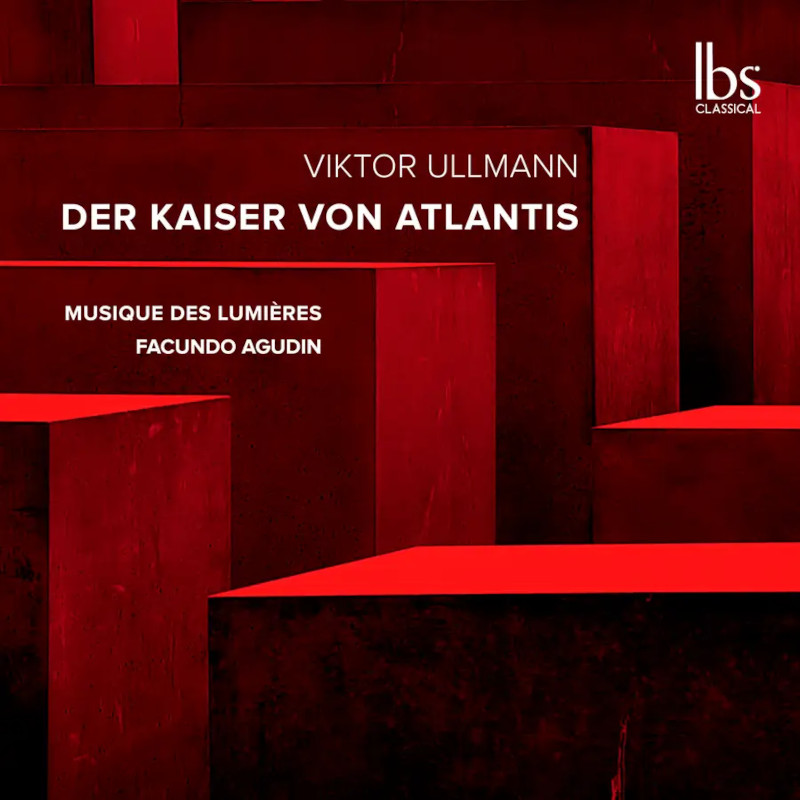
ULLMANN: Der Kaiser von Atlantis (The Emperor of Atlantis)
Anna Wall (Drummer), Natali Pérez (Soldier Woman), Sébastien Obrecht (Harlekin, a Soldier), Pierre-Yves Pruvot (Emperor Overall), Vasyl Slipak (Loudspeaker, Death).
Orchestre Musique des Lumières, conducted by Facundo Agudin.
LBS IBS32018—50 minutes. Click here to purchase.
Top image: The destruction of Atlantis (Гибель Атлантиды) by Nicholas Roerich (1928) [Source: WikiArt.org]