Composers have always been inspired to write for others: this is one of the rich seams of inventiveness running through so much music, old and new. Over many decades Dame Sarah Connolly has already distinguished herself in the fields of opera, oratorio and Lieder singing. It was therefore intriguing to hear in this recital how a number of contemporary composers have felt individually inspired by the versatility of Connolly’s voice to extend her repertoire still further. Musicians can so easily be pigeonholed in terms of background and style, so it is also good to be reminded that strict categorisation is largely unhelpful. It was Leonard Bernstein who declared that the terms “serious” and “light” when applied to music were irrelevant, only allowing a distinction between “good” and “bad” music.
At the heart of this recital lay the world premiere of a work by John Paul Jones, who spent twelve years as bassist and keyboardist with the rock band Led Zeppelin. Like many who went on to work in the field of “popular” music, he had a classical background, having been the organist at his local church while still in his teens. He is currently working on an opera based on a play by Strindberg, and upcoming performances include an organ concerto written for Olivier Latry. Jones’s song cycle Her Kind draws on four poems by feminist writers: Anne Sexton, Carol Ann Duffy, Angela Carter and Maya Angelou. Each text explores themes of womanhood, witchcraft and power.
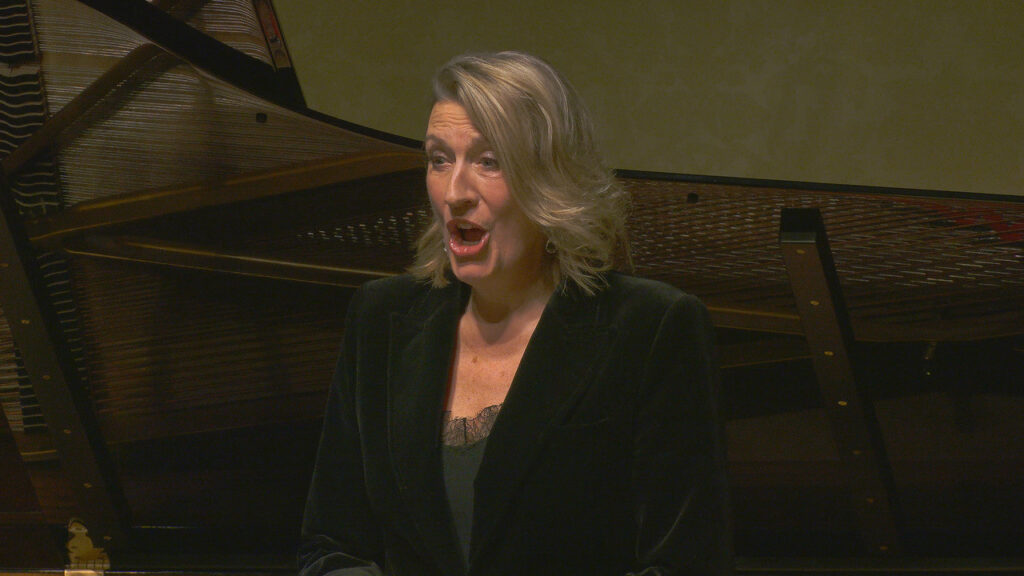
The words of these poems are extraordinarily powerful and they require a sympathetic response in terms of the music. Anne Sexton’s Her Kind, which also provides the title for this piece, immediately sets the tone in the opening lines: “I have gone out, a possessed witch, Haunting the black air, braver at night; Dreaming of evil…” The composer has described the music as “tonal but edgy”. It is certainly that. Mirroring the instrumentation of Schoenberg’s Pierrot Lunaire, with violin, cello, flute, clarinet and piano together with the solo voice, it is dark and dense at the start, emanating a forbidding aura, picking up an intense chill in the wind, with the bass clarinet adding touches of forceful inkiness. Connolly was alive to the significance of individual words, subtly shifting the mood for the first line of the second stanza (“I have found the warm caves in the woods”), matched by a glow in the accompaniment, before marching steps in the instrumental voices increased the pace for the concluding stanza. The amplitude in Connolly’s voice as it opened out for the final statement (“A woman like that is not ashamed to die. I have been her kind”) was quite remarkable. It is still a lustrous instrument, with finely sustained legato lines underpinned by consummate breath control as a defining feature.
I have always found Carol Ann Duffy’s poetry possessed of a searing intensity and striking turn of phrase. Jones takes her Pygmalion’s Bride, in which she explores the mythological story of the Cypriot sculptor who falls in love with the statue he has carved, and turns it into a gripping monologue for Connolly. The expressive power of the words (“Cold, I was, like snow, like ivory”, “my stone-cool lips”, “my marbled eyes”) was splendidly realised, the rippling effects at the start with piano arpeggios together with the sighing and groaning cello, and a haunting interlude between the third and fourth stanzas being especially potent. The sharpness in Connolly’s voice for “His nails were claws” revealed a compelling unity between words and music, and the downward rush of cascades in the ensemble just before “All an act” was an example of the composer’s ear for dramatic effect.
In Angela Carter’s Morning Glories there was an essential feeling of sadness, signalled by the soft piano chords at its opening and balanced at the close by Connolly’s whispered introduction to the final stanza. Only once did I feel that Jones’s high quality of inspiration lessened: for the line “She is so old she has lapsed into a dreaming plant life” the rising crescendo for the voice fails to achieve a consonance with the text at this point.
For Maya Angelou’s poem Phenomenal Woman, which here formed the concluding song I Say,I found myself transported into Scott Joplin territory, and very convincingly so. With Joseph Middleton’s obvious delight in the piano syncopations of ragtime and Connolly’s pronounced American accent, this turned into a frolicsome romp. However, the assertiveness and self-confidence of the text could have come across even more strongly had Connolly used more expressive body language, choosing instead to adopt more of an intimate and confiding tone.
It was a tribute to Connolly’s ability to inspire affection that the living composers represented here were present in the audience. Not everything succeeded in turning a stimulus into substance. Helen Grime’s Prayer, based on Duffy’s poem with the same title, was by far the most discordant of the items. A wide tessitura for the voice was on display, making maximum use of Connolly’s rich chest tones and the intensity present in a cry of despair (“Pray for us now”), but the prevailing restlessness in the music ran counter to the need for calm and introspection in all orisons. Was Duffy influenced by the oft-voiced comment by listeners to BBC Radio 4’s late-night shipping forecast that its steady incantations helped them relax into the arms of Morpheus? At any rate the closing line (“Rockall. Malin. Dogger. Finisterre”) had an aptly soothing quality to it, fortified by the imaginative way in which the accompaniment slowly wound down to its conclusion.
Tony Banks’s Mad Man Moon, in an arrangement by Peter Gritton, provided a further demonstration of Connolly’s versatility. Here she was, almost echoing Victoria Wood’s piano monologues, in a purely narrative piece, seated at the keyboard and delivering her text with a welcome sassiness, matched by the jaunty and jig-like ensemble work with abundant flute arabesques, the voice imbued with a beat and a swing.
In Bob Chilcott’s five-movement piece, Sky Pictures, it was Charles Bennett’s words for the fourth piece, Cloud Language, which left the greatest impression on me. Here the extended metaphor of the sky as a blue page on which the clouds appear “as soft, white words that speak of weather” was very satisfyingly conveyed by Connolly’s warm, reflective and intimate tone that culminated in a quite moving final stanza, text and music in perfect harmony.
Connolly had started her evening with a French entrée, two songs from Ravel’s cycle Shéhérazade and a rare outing for André Caplet’s Viens! Une flûte invisible soupire. For all her undoubted skills as a performer, I have never felt entirely comfortable hearing Connolly’s voice in the French repertory. Her dynamic range was certainly manifest, from gently lyrical lines to moments of passionate intensity. Yet syllable endings often lacked idiomatic conviction, I struggled to hear the innate sensuousness and above all the characteristic Gallic tang was simply not there. None of this, however, detracted from the vibrancy of Thomas Hancox’s flute playing, also in evidence in his solo piece, Debussy’s Syrinx.
This was a wide-ranging evening’s entertainment, with judiciously placed instrumental interludes that included a highly atmospheric interpretation of Sally Beamish’s The King’s Alchemist, with echoes of Scottish folk tunes as well as pizzicato and col legno effects for the string players, and a solo for Joseph Middleton by Mark-Anthony Turnage. But ultimately it was the warmth and radiance of Connolly’s voice which confirmed her standing as one of the UK’s most celebrated mezzos.
Alexander Hall
A world premiere for Dame Sarah Connolly
Maurice Ravel – La flûte enchantée & L’indifférent (from Shéhérazade); André Caplet – Viens! Une flûte invisible soupire; Claude Debussy – Syrinx; Sally Beamish – The King’s Alchemist (Cantus/Aqua Vitae/Pavana/Avis Hominis); Bob Chilcott – Sky Pictures (Sky Plough/Sky Pictures/Seagulls/Cloud Language/Cloud River); John Paul Jones – Her Kind (world premiere) (Her Kind/Pygmalion’s Bride/Morning Glories/I Say); Helen Grime – Prayer (from Eight Songs of Isolation); Mark-Anthony Turnage I look into my Glass (from Songs of Sleep and Regret); Tony Banks – Mad Man Moon; Kurt Weill – It was never you (Knickerbocker Holiday); Kurt Weill – What good would the moon be? (Street Scene)
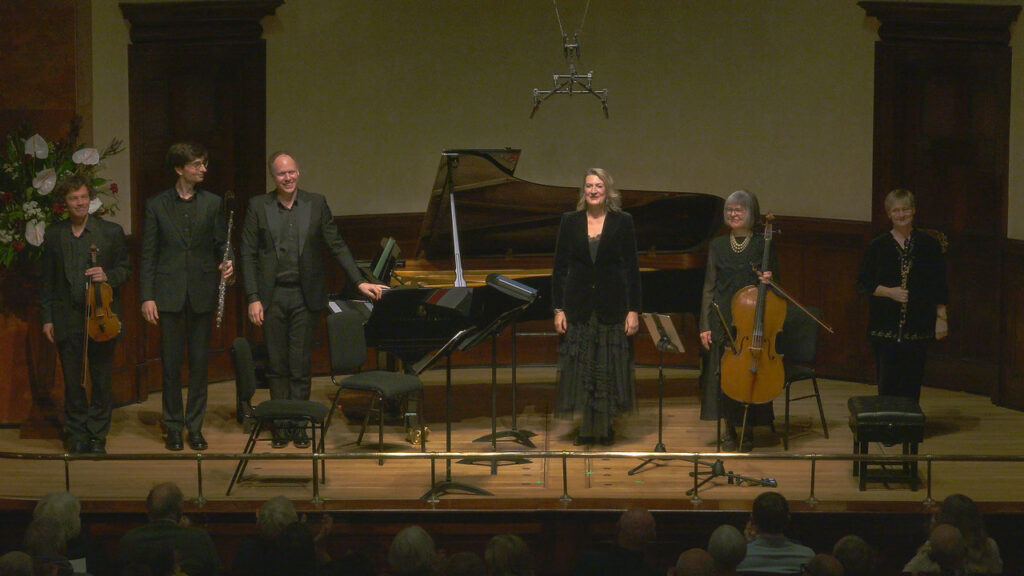
Dame Sarah Connolly (mezzo-soprano). Joseph Middleton (piano). Members of the Britten Sinfonia: Marcus Barcham-Stevens (violin); Caroline Dearnley (cello); Thomas Hancox (flute); Joy Farrall (clarinet).
Wigmore Hall, London, 8 January 2026
Top Image: Dame Sarah Connolly, Joseph Middleton and members of the Britten Sinfonia
All Photos © Tom Wright