Do you want screams, blood-curdling cries, the unearthing of a buried axe, twisted minds messing with your own head? Richard Strauss gives it to you all in his Elektra. Those brought up on Psycho and Jaws will know the power of suggestive music, though neither Bernard Herrmann nor John Williams had the luxury of a 110-piece orchestra at their disposal. Not that Alan Gilbert with the NDR Elbphilharmonie Orchester quite mustered that number: he had just six double basses but there were still enough instruments to make the walls of this concert-hall quake and shake.
Gilbert is especially good at doing the hard-edged, existentialist dramas; I recall a particularly fine performance of Duke Bluebeard’s Castle with his Hamburg forces in February 2024, so all the high drama in Elektra played to his strengths. He controlled the sudden eruptions of massive sound with sure-footedness, laying bare the structural bones of the piece and maintaining a brilliance in the textural detail. Just before the cries of Klytämnestra and Aegisth issue forth at their murder, Gilbert and his lower strings created one of those unnerving musical moments when it seems as though the walls of Babylon come crushing down. However, there were two things I missed in his treatment of the score. His observance of the composer’s lyrical vein was not always sufficiently developed, especially when tenderness was being expressed in the vocal line. Though his orchestra played very well for him, with power and plenty of punch, Straussian opulence was in short supply, not helped by the Elbphilharmonie’s crystalline acoustics which favour transparency over warmth.
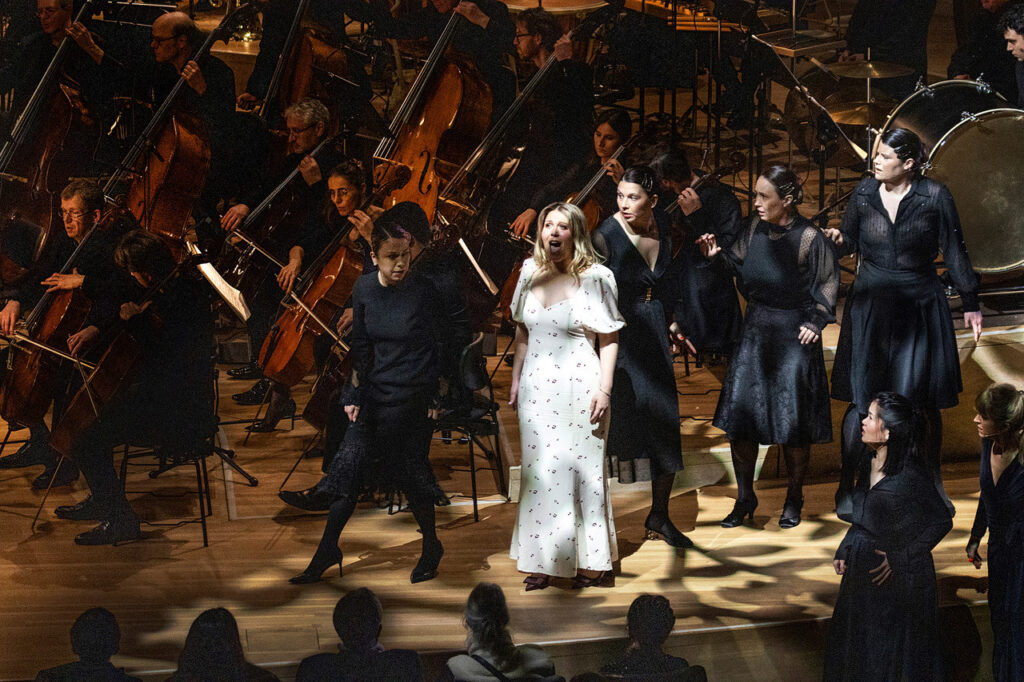
This is essentially an opera for three strong female voices; the men hardly get a look-in. I sometimes wonder what Scandinavians, in particular the Swedes, put in their water. They seem to have an uncanny knack of producing great dramatic sopranos who can sing the heavy Wagnerian roles as well as the trio of powerful women in Elektra. Perhaps the answer would be the same as for those who muse on the extraordinarily large number of Finnish conductors there are in the world today. It has something to do with role models. In the case of dramatic sopranos that would be Birgit Nilsson. Here, we had Ingela Brimberg as Elektra and her fellow Swede Christina Nilsson as her sister Chrysothemis, with Karita Mattila as the doomed matriarch Klytämnestra.
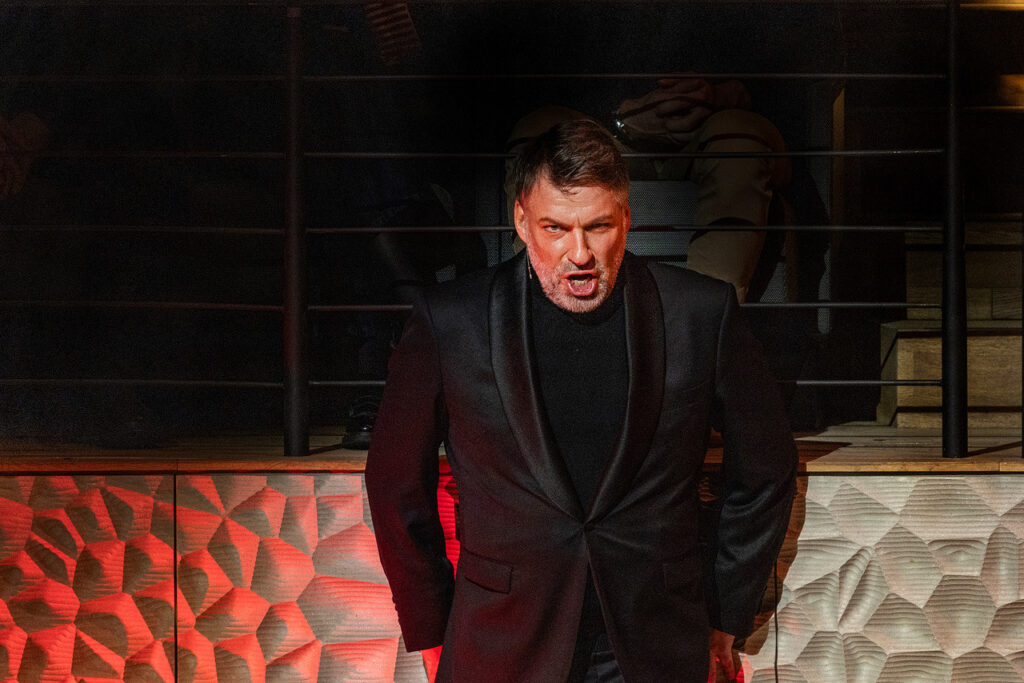
This performance was given in a semi-staged version, the Elbphilharmonie being deployed as a theatrical arena within which a cauldron of sound seethed and bubbled with emotional energy. It helped that everybody sang from memory and that the garish lighting, dominated by the reds, gave an additional visual link to the blood that had been spilled and was about to be spilled. The voices of the NDR Vokalensemble positioned on the upper levels together with the extra trumpets created a further aural chill when the bloody events in the family household unfolded.
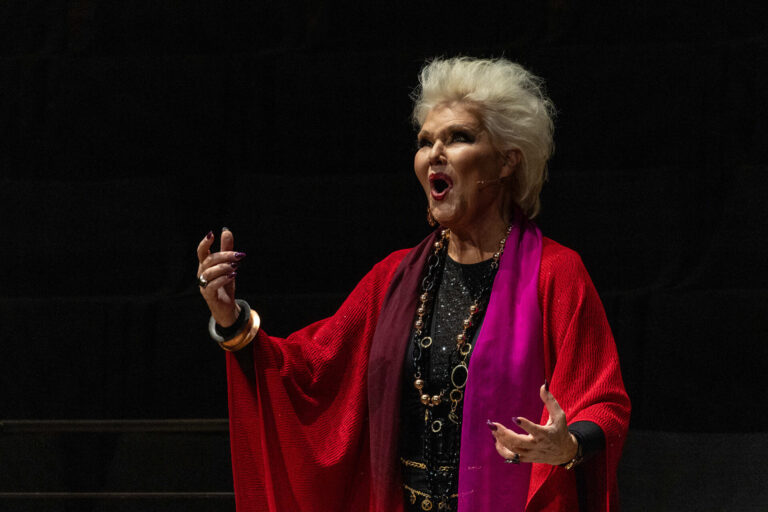
In Strauss’s opera there is no divinely imposed pattern of retribution, nothing approaching the biblical “Vengeance is mine; I will repay, saith the Lord”, and no Furies to goad and torment Orest. Instead, the librettist Hugo von Hofmannsthal depicts Elektra as an obsessional neurotic, high on the thought of blood, driven to avenge the murder of her father and impelling her long-lost brother Orest to kill their own mother Klytämnestra and her lover Aegisth. The foul deeds were done and dusted in this particular case in just 105 minutes.
What the character of Elektra needs above all is stamina; beauty of line is not a pre-requisite. Brimberg had an initial spread which slightly worried me, but she projected strongly and maintained focus to the end, growing with compelling intensity into the waves of ecstasy as she performed her final dance. Those moments of tenderness which show her vulnerability, as in some of the exchanges with Chrysothemis, who in turn is obsessed with the idea of marriage and motherhood, or the annunciation scene with Orest when she declares “Elektra heiß’ ich”, deserved a little more softness at reduced dynamic levels, though Gilbert must also take responsibility for not reducing the pulse here. Similarly, a few of her extended monologues would have profited from more shade as well as light.
Nilsson was a bright-toned and youthful-sounding Chrysothemis. Drawn into her sister’s dark and disturbed mind, she cut a forlorn figure as she battled between familial loyalty and the urge to effect vengeance, handling the high-lying tessitura with assurance. Her “Eh’ ich sterbe, will ich auch leben!” was flung out with calculated determination, lines such as “Es muss etwas geschehen sein“ were delivered with a chilling sense of foreboding, and at the very end, as she intoned “Liebe ist alles! Wer kann leben ohne Liebe?” the voice was wrapped in human warmth.
Even if Mattila’s voice now shows signs of fraying, with less body and radiance at the top, she compensated wonderfully through her acting skills. Looking like the kind of woman you mess with at your peril, dressed in a black outfit with elaborate gold ticking and a scarlet shawl, the still-smoking charcoal in the voice emphasised the darkness weighted in her character. The pointing fingers and stamping of her feet did the rest. You felt the huge burden of guilt upon her when, like Lady Macbeth, she sang of the torments of her sleeplessness, a feeling of being devoured from within.
Of the men, Andreas Bauer Kanabas stood out for me. He sang a commanding Orest, and in his deepest sepulchral tones reminded me of another of this composer’s characters, Jochanaan in his subterranean cistern. The rock-steadiness in his voice during the questioning of his sister before the truth gradually dawns maintained a rising tension and expectancy, and his concern for Elektra’s state of health, her “ghastly eyes” and “hollow cheeks”, was full of touching concern.
One reason why this opera cuts audiences to the quick, unsettling even in Elektra’s haunting cries of “Agamemnon!”, is because the events revolve around a family unit and are played out in the one place where everybody should feel naturally safe, namely the home. Before the writing of the opera, Freud was already exploring how unresolved childhood traumas can create fertile ground for later mental health problems. In his 1967 BBC Reith Lectures, the distinguished social anthropologist Sir Edmund Leach declared: “Far from being the basis of the good society, the family, with its narrow privacy and tawdry secrets, is the source of all our discontents.” There are plenty of tawdry secrets and instances of neurosis in Elektra. The human mind will always be a breeding ground for dark and dangerous thoughts.
Alexander Hall
Elektra
Opera in one act, Op. 58
Music by Richard Strauss
Libretto by Hugo von Hofmannsthal based on Sophocles
Semi-staged performance sung in German with German surtitles
Klytämnestra – Karita Mattila; Elektra – Ingela Brimberg; Chrysothemis – Christina Nilsson; Aegisth – Benjamin Bruns; Orest – Andreas Bauer Kanabas; Overseer – Layla Claire; First Maid – Marie Henriette Reinhold; Second Maid – Ida Aldrian; Third Maid – Marie-Luise Dreßen; Fourth Maid – Olivia Boen; Fifth Maid – Chelsea Zurflüh; Orest’s tutor – Fabian Kuhnen; Klytämnestra’s confidante – Alexandra Hebart; Klytämnestra’s trainbearer – Chloe Lankshear; A young servant – Liam Bonthorne; An old servant – Andreas Heinemeyer; NDR Vokalensemble; NDR Elbphilharmonie Orchester, conductor Alan Gilbert
Elbphilharmonie Grosser Saal, Hamburg, 13 February 2026
Top image: Ingela Brimberg as Elektra
All photos © Thies Rätzke