Der Schatzgräber is one of a series of operas which Schreker wrote in the first decades of the 20th century with an esoteric, folktale narrative, usually in a mediaeval setting. Through a blend of realism and symbolism, the opera addresses themes of Freudian psychology, mysticism, and erotic yearning and disappointment, as though a story from the Brothers Grimm is expanded into a sophisticated music drama.
The treasure seeker of the title is the elusive minstrel Elis, who is able to discover hidden treasure with the aid of his magic lute. He is enlisted by the King’s Jester to recover the Queen’s missing jewels, whose possessor is guaranteed eternal youth. In the meantime, they have been acquired by the innkeeper’s daughter, Els, apart from a necklace which is to be offered to her as a wedding present by her third fiancé, a boorish country squire. She arranges for his murder by her servant, Albi, as she has done with her previous fiancés, having incited Albi to steal the other jewels. When the minstrel appears with the necklace, he seems to be the manifestation of the man she has dreamed about to fulfil her desires, although he is also charged with the murder of Els’s fiancé. The Jester saves him from execution, but he is disarmed of his lute by Els and, in a long love duet, is entranced by her, decked out in the jewels. Her deceptions are revealed at a banquet, leading to her rejection by Elis, and she is only saved from execution on the basis that the King had promised the Jester whatever he wants on the successful discovery of the jewels, and he asks for Els as his wife. Nevertheless, in the opera’s Epilogue, she remains unfulfilled and dies, after having been consoled by Elis who sings of their idealised love in eternity.
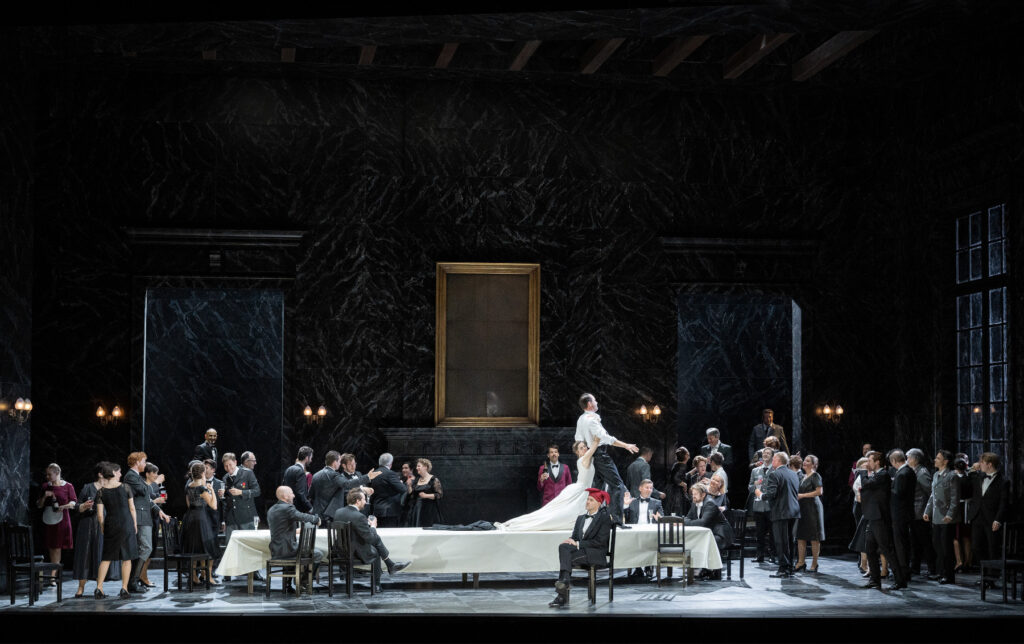
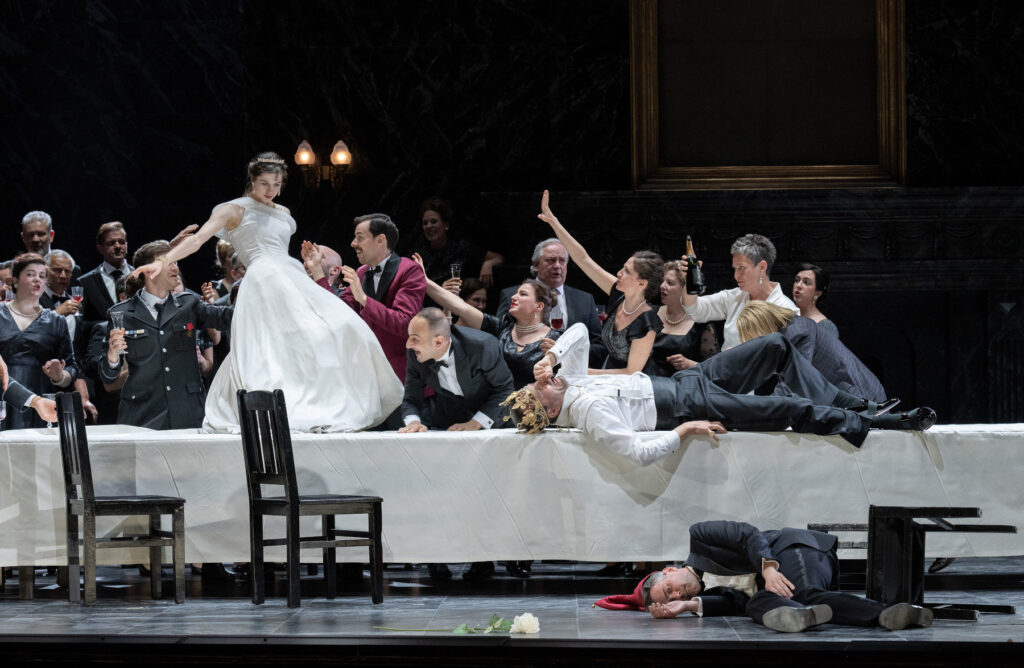
Despite the heady, pregnant symbolism of the narrative, Loy’s production errs decidedly on the side of realism. He explains that his interest in the work is centred on Els as a complex female figure, who is not a victim but ‘defies and disrupts the system’. That system is present for more or less the whole drama, as an authoritarian society of the 1920s or ’30s under whose critical scrutiny the central characters have to contrive some meaningful existence: the Jester, like Rigoletto, employed by the court but not really a member of it, and so a social outsider; Els, relatively lowborn, who reflects back to the court its superficial life of glamour and pleasure by her obsession with the Queen’s jewels, but nevertheless seeking something more meaningful than the relationships found within it; and the minstrel Elis, who comes and goes mysteriously, not belonging to any particular society or community but whose art establishes his own status and worth against the court’s utilitarianism. Eroticism is the point at which the two sides intersect as, during the scene of Els and Elis’s rapture in Act Three, the courtiers are prompted to an orgy.
A strike by a union affecting some theatre staff on the occasion of this particular performance meant that no background scenery had been assembled. The set and costumes were in place, and given Loy’s usually austere settings, the lack of décor didn’t feel like a significant omission from this presentation. Photographs in the programme show that the production’s gloomy marble walls are not dissimilar from the stark black edifices of the set’s basic structure left in place on the stage for this performance. Changes of scene between the court, Els’s inn, and more public settings were more difficult to trace, given the nearly continuous presence of onlookers in Loy’s conception of the opera with little distinction between either spaces or people. But in a sense, probably that inadvertently underlined Loy’s point about the predicament of the individual characters at the centre of this drama, working out their destinies among the stultifying conventions and hypocrisies of uniform, impersonal society at large. And the relatively uncluttered, if not entirely blank, slate allowed the audience to make what it would of Schreker’s complex web of symbols, allied to a busy score, rather than be cajoled into any specific angle on them.
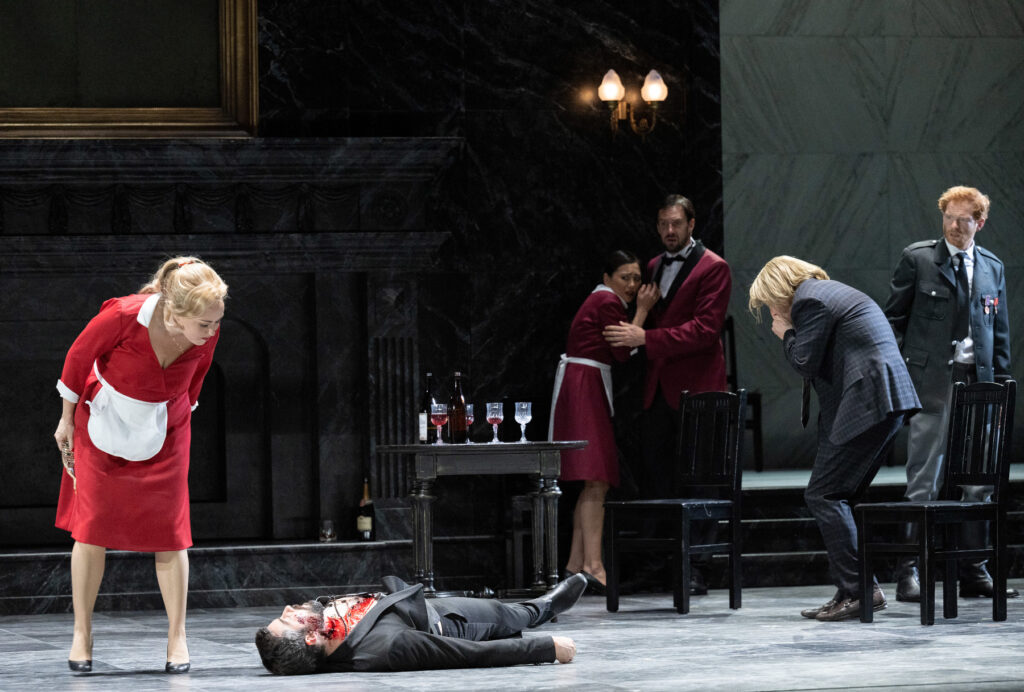
Olesya Golovneva’s account of Els skilfully captures Loy’s interpretation as a defiant, if complex, figure: variously assertive and lyrical, but also doubtful, both of herself and others. Daniel Johansson sustains warm tone as Elis but with a neutrality and resilience to indicate that the minstrel stands cautiously apart from those he encounters. Thomas Cilluffo is invested in the part of the Jester with a nervous excitability and engagement, stirring compassion as he leans over the dying Els in the Epilogue, while Jared Werlein is a rightly dispassionate King. Good, characterful performances depict the other roles, bordering on the quirky or sinister, for instance in the case of Tómas Tómasson’s Bailiff or Byung Gil Kim’s Young Nobleman, or Clemens Bieber’s busybody Chancellor.
The choir of the Deutsche Oper form a serious, committed cast of extras in the drama, not histrionic.
Marc Albrecht must know this opera better than any other conductor alive. He assisted with a production at Hamburg in 1989 from which a CD recording issued (on the Capriccio label, conducted by Gerd Albrecht – no relation). His own conducting of a production for Netherlands Opera in 2012 was preserved on disc, as well as the first outing of the present production by the Deutsche Oper in 2022 on DVD, with some different singers. He maintains a secure grasp of the score, with a lucid reading which attends at least as much to the influence of Debussy and musical Impressionism, for want of any straightforward term for that style, as to that of Strauss or of Expressionism and Schoenberg. Phrases and melodies glimmer over the music’s surface, hinting at thoughts and feelings beyond what one sees on stage.
Schreker’s opera doesn’t necessarily give up its secrets easily, and its literary and musical details reward repeated viewing and hearing. In bringing a transparent lens to it, Loy and Albrecht’s handling of the work stimulates our imagination to look beyond external, everyday simplicities.
Curtis Rogers
Der Schatzgräber
Composer and Libretto: Franz Schreker
Cast and production staff:
The King – Jared Werlein; The Queen – Doke Pauwels; The Chancellor – Clemens Bieber; The Count / A Herald – Philipp Jekal; The Schoolmaster / The Mayor – Joel Allison; The Jester – Thomas Cilluffo; The Bailiff – Tómas Tómasson; The Young Nobleman – Byung Gil Kim; Elis – Daniel Johansson; The Scribe – Michael Dimovski; The Innkeeper – Bart Driessen; Els – Olesya Golovneva; Albi – Patrick Cook; Land servant – Volodymyr Morozov; Three female voices – Asahi Wada, Margarita Greiner & Ireene Ollino
Director – Christof Loy; Set designer – Johannes Leiacker; Costume designer – Barbara Drosihn; Lighting designer – Olaf Winter; Dramaturg – Dorothea Hartmann; Chor und Orchestra der Deutschen Oper Berlin; Conductor – Marc Albrecht
Deutsche Oper Berlin, Germany, Saturday 7 February 2026
All photos © Monika Rittershaus