After fifteen years with a home at the Kennedy Center Terrace Theater, Artistic Director Patrick Quigley announced before Opera Lafayette’s concert at St. Francis Hall on Thursday that the company decided to move only last year, and that this Queen of Hearts concert not only would be using a new venue, but also a new format.
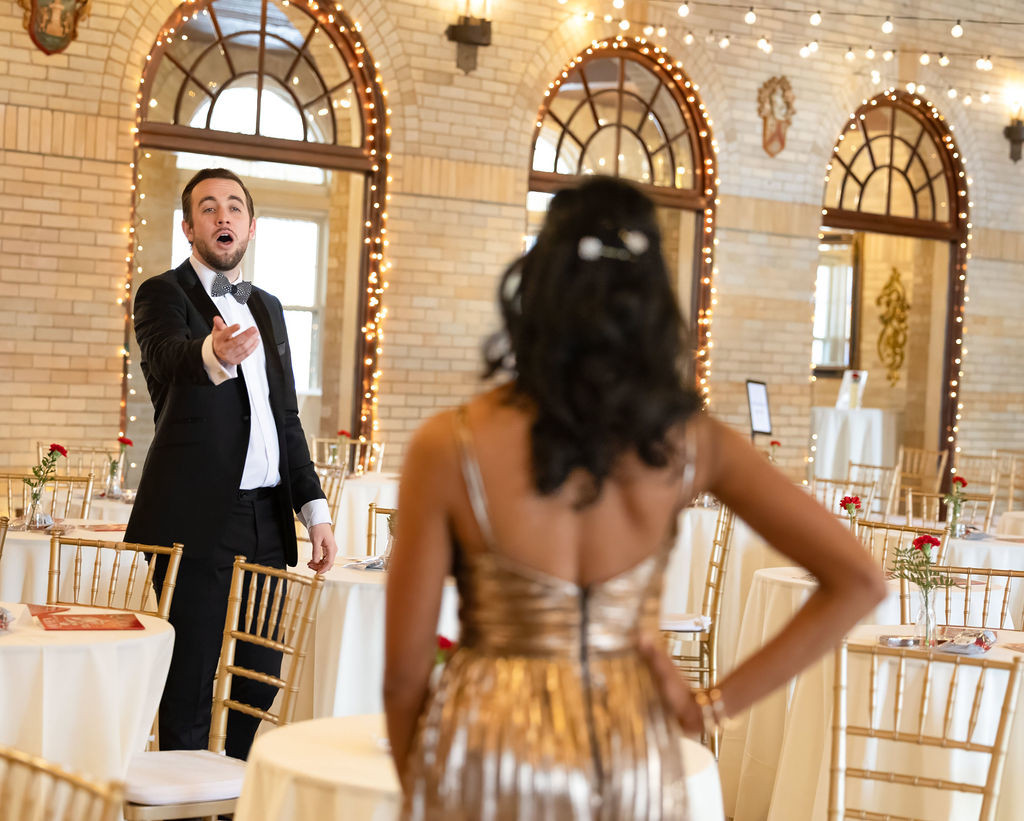
Regardless of whether anyone foresaw this change for the company, it is clear that this new venue and cabaret format is the best thing that could possibly have happened for them. This was a more intimate evening at a beautifully-adorned venue with early music instruments and string lights above the audience and in entryways, creating a feeling of warm, soft, gentle love that pervaded the atmosphere perfectly in line with the theme of Valentine’s Day. Tables were available for guests as well as regular concert seating, and everyone was invited to partake in beverages available at the venue bar. On the tables, too, chocolate treats awaited to give the concertgoer a full sensory experience. Although there was a marked contrast in lighting between stage and floor, it did not bother me because I was enjoying the performances so much.
Musically, one of the highlights of the evening was the fact that the program consisted of both instrumental and vocal works. Also special was curator and host Nic McGegan reciting some selected poems during each part of the program. He got laughs during Thomas Jordan’s “Epicure” as well as during the overtly and hilariously sexual “Sylvia the Fair” by Dryden and the naughty and raunchy “Cupid’s Nightcap” by Stanley J. Sharpless, a poem that was inspired by the writer hearing that cocoa was an aphrodisiac and won a poetry competition in the 1960s. Suffice to say that this curator is the consummate performer, not only expertly collaborating with the ensemble at the harpsichord, but also acting every poem perfectly and holding the audience rapt.
Soprano Maya Kherani opened the vocal part of the program with Henry Purcell’s “If Music be the food of Love.” She has a beautiful presence and voice with excellent diction even in melismatic passages. She also got the first laugh of the evening with Pelham Humfrey’s “Oh that I had a fine man” and throughout the evening in several numbers showed her skill with comedy. Vocally, her showstopper for the evening was Giovanni Paisiello’s “Nel cor più non mi sento,” which every student who has ever gone through a university or conservatory vocal music education has heard, but never like this. In the first place, I was beyond pleased to hear this with a Baroque ensemble instead of a piano. Beyond that, and most importantly, here Kherani gave a masterclass in performing this piece, and indeed every university and conservatory should play a recording of her performance to show both Baroque ornamentation and acting choices. She gave us not one but two returns, two sets of ornaments on display, and it was not too much. What can one say except: This is how it’s done.
Tenor James Reese likewise showed himself to be a master of Baroque style. In the first place, both his and Kherani’s voices are ideal for Baroque music, neither pushing nor needing to push the entire concert, and still the audience heard every note and word. Particularly noteworthy in the first part of the program for Reese was Honoré d’Ambruis’s “Le doux Silence.” Something about the quality of his voice in the French language was particularly arresting. It was hugely seductive in its gentleness and softness. It goes to demonstrate that power in music can come just as much from ease as from force, in fact, perhaps even more so.
To close the first part of the program, Kherani and Reese sang Henry Lawes’s “Dialogue upon a kiss.” I loved the staging director Erica Ferguson created for this. It did not look or feel like stock opera but rather the best kind of playful yet sincere dialogue between lovers. While this particular moment stood out to me, it’s important to note that Ferguson’s use of space throughout the entire concert was well-done, especially considering that they only had one rehearsal at the venue.
The ensemble opened the second part of the program with Nicola Matteis’s “Adagio” from his Suite in C. Here I loved the character and dialogue between the first and second violins. This was a moment that made very clear how the instrumental ensemble was just as much a character in the performance as the singers. This segued immediately into Claudio Monteverdi’s “Bel Pastor,” which revealed attire changes for both Kherani and Reese. In top soprano fashion, Kherani had changed into a gold dress that made her seem as if she had become light itself. And yet, her beauty did not overshadow her humor. Her rendition of Thomas D’Urfey’s “Oh Mother, Roger with his Kisses” in a character voice was genuinely hilarious, as was her cozying up to a stuffed toy dog during Reese’s singing of William Mountfort’s “Monsieur le Chien” and singing around Reese as he laid back and snored during Purcell’s “Dear Pretty Youth” from The Tempest.
Closing the second part of the program was an excerpt “Quel tuo visetto” from Franz Joseph Haydn’s Orlando Paladino. Known better for his instrumental music and oratorios than from his operas, it struck me that Haydn does here what he does in the “Surprise” symphony and the “Joke” quartet: The audience is laughing before they even know it. Nevertheless, a great composer needs great interpreters to execute their work, and it would not have worked so well had not Kherani and Reese played the scene as well as they did.
The final part of the program was entitled “Amor vincit omnia” (“Love conquers all”), and it opened with Matthew Locke’s “Broken Concert No. 6 Ayre.” This broke the humor of the second part of the program a little bit in order to give the triumphant feeling that the title of this part of the program suggests.
Vocally, no Baroque concert of love songs would be complete without “Pur ti miro” from Monteverdi’s L’incoronazione di Poppea. One normally hears this with a soprano and mezzo-soprano since Nero is a pants role, and one may prefer that kind of pairing, but this was so well-acted and sung that it is easy to see how a director would cast Reese as Nero. He gives mezzos a run for their money, especially when he approaches falsetto range.
In conclusion, the entire experience of Queen of Hearts, from the hospitality to the performances, made it the perfect concert to attend prior to Valentine’s Day. Let us hope that Opera Lafayette continues to see such a good reception with future productions as they continue a new era outside of the Kennedy Center.
Maggie Ramsey
Opera Lafayette: Queen of Hearts
Nicola Matteis – ‘Prelude from Suite in A,’ ‘Aria Amorosa from Suite in e minor,’ ‘Adagio from Suite in C’; Thomas Campion – ‘Now winter nights’; Henry Purcell – ‘If Music be the food of Love,’ ‘I attempt from love’s sickness,’ ‘Dear Pretty Youth’ (The Tempest), ‘The Knotting Song,’ ‘When first I saw bright Aurelia’s eyes’ (Dioclesian), ‘Sweeter than Roses’ (Pausanias), ‘Man is for the woman made’ (The Mock Marriage); Pelham Humfrey – ‘Oh that I had a fine man’; Honoré d’Ambruis – ‘Le doux Silence’; William Lawes – ‘To Virgins to make much to Time’; Thomas Jordan – ‘The Epicure’; Giovanni Paisiello – ‘Nel cor più non mi sento’ (L’Amor Contrasto); British Folksong – ‘When cockleshells’; Anonymous – ‘Somebody’; Henry Lawes – ‘Dialogue upon a kiss’; Claudio Monteverdi – ‘Bel Pastor’; ‘Pur ti miro’ (L’incoronazione di Poppea); Thomas D’Urfey – ‘Oh Mother, Roger with his Kisses’; William Mountfort – ‘Monsieur le Chien’; Dryden – ‘Sylvia the Fair’; Joseph Haydn – ‘Quel tuo visetto’ (Orlando Paladino); Matthew Locke – ‘Broken Concert No. 6 Ayre’; Stanley J. Sharpless – ‘Cupid’s Nightcap’
Nicolas McGegan – Curator and Host; Maya Kherani – Soprano; James Reese – Tenor
Harpsichord – Nicholas McGegan; Violin I – Natalie Kress; Violin II – Rebecca Nelson; Cello – Alexa Haynes-Pilon; Theorbo and guitar – William Simms
Movement Director – Erica Ferguson
St. Francis Hall, Washington, D.C., February 12, 2026
All photos by Jennifer Packard Photography