A venue that demands nothing less than the best singing, and with its own top-tier choir to prove it, this past weekend Washington National Cathedral played host to a smaller ensemble more than worthy of that space, The King’s Singers.
Entering into the enormous gothic cathedral, one understands that the very architecture is part of the sound-world being created. The King’s Singers is an ensemble of six, yet by, among other things, anticipating how long it will take certain vowels and consonants to resonate throughout the cathedral, they command the space and hold the audience in the palm of their hand. Yes, they were amplified, and one can’t help but wonder what it would be like if they were not, but the sound engineering was such that the amplification was not a distraction but rather the enhancement that it should be.
The first thing to note about this ensemble is their astounding sense of pitch, both individually and as a group. The pitch pipes they used were mostly inaudible to the audience, making the experience all the more impressive because it felt like their music came out of nowhere, manifesting with instantaneous perfect harmony. It’s the kind of experience that is just the thing to make you feel better if you arrive at the concert out-of-sorts. Furthermore, the harmonies are not only tight but also have a sense of drama about them. Even the religious texts were painted acoustically as a drama. In the Epilogue of Geoffrey Poole’s Wymondham Chants, for example, the men split into two groups of three, with one group retreating further into the cathedral. I loved the effect of not seeing, but hearing, the second group. Gradually the second group got closer again toward the end of the piece, but still managed to sound distant before rejoining their colleagues up front.
True to the concert’s title, the program before the interval consisted of sacred pieces divided into four sections: “Angels” and “Demons,” and perhaps less expectedly, “Mother,” and “Son.” The standout pieces in this first part of the program were Poole’s Wymondham Chants, presented not sequentially but rather in the appropriate category based on the text, for example, Mary Modyr concluding the set of pieces to do with “Mother,” Jesus’s mother Mary. This piece in particular also stood out among the rest for its text, which becomes a dialogue between Mary and Jesus as He hangs on His cross. Interestingly, the group did not rearrange their formation until this piece, over halfway through the first part of the program.
As delightful as they are as an ensemble, I also loved that they each got solos or at least soloistic moments to show off their voices, because even among voice types there were different colors of sound. Bass Jonathan Howard in particular impressed with the richness of his instrument in his solo on Bob Chilcott’s “The Human Family” with text by Maya Angelou.
The second half of the program, “Songs of harmony and hope,” was something of a “King’s Singer’s jukebox,” as they put it, with arrangements created specially for the ensemble. Entitled “Songs of harmony and hope” on the program, according to the singers they get to choose exactly which songs to sing based on how they are feeling that day. Appropriately for the times, the first piece they chose was a favorite of The Reverend Dr. Martin Luther King, Jr., “If I can help somebody.” Despite the heaviness pervading the United States right now, this arrangement, like the rest of the concert, offered some light and hope in the darkness. This was followed by the Disney classic “Cruella de Vil,” in an arrangement which, much to the frustration of female singers everywhere, became a masterclass in how male voices don’t have to change much in order to switch genres, but rather can go back-and-forth between folk and popular styles with ease. Beyond that, in the second part of the program the classic “Danny Boy” stood out as a welcome surprise that brought chills. With just a key change in the second verse, the character of the piece changed and ensured the audience’s rapt attention.
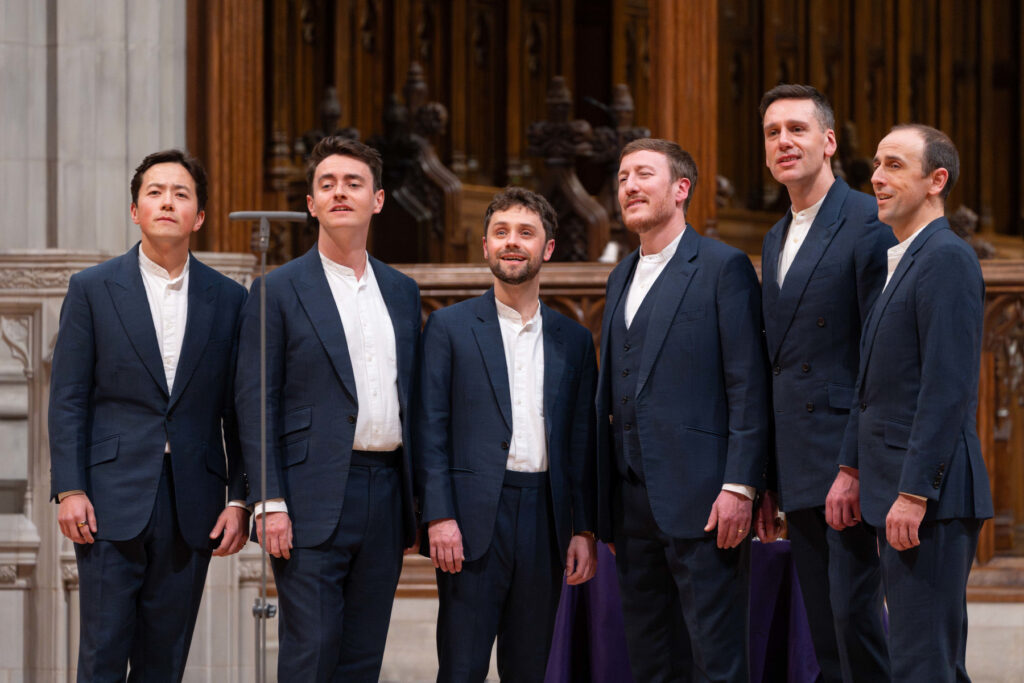
Besides the quality of sound, it is noteworthy how elegant and charming this ensemble is visually. They featured navy suits, one with a double-breasted jacket, some two-piece, some three-piece, and they all had the top button of their dress shirt unbuttoned with the corner tastefully folded. It was a uniform that didn’t feel like a uniform, but rather showed them as classy professional musicians while still giving them some choice in what to wear and show their individuality. Finally, it did strike me that, somehow, everyone looked like their voice part.
All in all, this performance was deservedly well-attended. I only wish I could have attended the second performance to see if the singers chose different songs for the second half. Regardless, this was well-attended and well-received, proving the power that music made exclusively with human voices has to touch hearts, speak to people when they need it most, and bring them together. After all, in the words of Maya Angelou sung at the performance I attended, ‘We are more alike than we are unalike, my friends.”
Maggie Ramsey
The King’s Singers: Angels and Demons
Geoffrey Poole – ‘Prologue: Ave rex angelorum,’ ‘Scherzo: Tutivilius’ ‘Prayer: Mary Modyr,’ ‘Epilogue: Blessed Jesu’ (Wymondham Chants); Edward Bairstow – ‘Psalm 67’; William Byrd – ‘Haec dies,’ ‘Miserere Mei Deus’; Arvo Pärt – ‘Zwei Beter’; Judith Bingham – ‘Ave virgo sanctissima’; Giovanni Pierluigi da Palestrina – ‘Regina coeli’; Hans Leo Hassler – ‘Cantate Domino’; Maurice Duruflé – ‘Ubi caritas’; Mel Leven – ‘Cruella de Vil’; Bob Chilcott – ‘We Are’; Michael Flanders & Donald Swann – ‘Slow Train’; George Gershwin – ‘Love Is Here To Stay’; Traditional Irish – ‘Danny Boy (Londonderry Air)’; Cy Coleman – ‘The Rhythm of Life’; John David – ‘You Are The New Day’; arr. Stacey V. Gibbs – ‘If I Can Help Somebody’
Patrick Dunachie, Edward Button – Countertenors; Julian Gregory – Tenor; Christopher Bruerton, Nick Ashby – Baritone; Jonathan Howard – Bass
Washington, D.C., February 6, 2026
All photos by David Starry