In the grand scheme of things, Julius Caesar and Cleopatra weren’t the most erotic or passionate of all lovers in history, nor does their story of alignment stand out as especially unique. Money, power and influence have always mattered more in the affairs of humankind than anything else, and sex has invariably been the weapon of choice. Current preoccupations in the media with revelations of relationships in high places erroneously thought to have been protected from the light of day merely underline this fact.
Decades before the onset of the Common Era, Rome already dominated not only the entire Mediterranean but territory beyond, including all trade in frankincense from Arabia. Before the start of Handel’s opera Giulio Cesare in Egitto, Caesar has been engaged in a Roman civil war, pursuing his rival Pompey the Great as far as Egypt. Here, he is drawn into the family feud affecting the Egyptian royal family, the Ptolemies. For many generations they had practised brother-sister marriages, but as so often sibling rivalries influenced key developments. When Caesar arrives, the young Cleopatra has been trying to regain control over their lands from her brother Tolomeo. Nicola Francesco Haym’s libretto is very loosely based on historical events and focuses on both the inner turmoil of the principal characters as well as the outer political turmoil of the time.

This performance in Hamburg of Handel’s opera Giulio Cesare in Egitto was part of a run of ten performances in European cities (not unsurprisingly leaving the UK out in the cold) by Il Pomo d’Oro.For an ensemble which was only founded in 2012, it has quickly established itself as a foremost interpreter of Baroque music. Here, fielding not quite thirty musicians and under the fleet and energising direction of its principal guest conductor, Francesco Corti, it reasserted claims for this being one of the finest, if not the greatest, operas of the period.
Concert performances of operatic works can be problematic. With the instrumentalists taking centre-stage in the Elbphilharmonie, the focus was clearly on the music itself. In the crystalline acoustics of this hall all the felicities of the score were heard to good effect, including the use of four horns for the opening and closing choruses, the obbligato hunting horn for Caesar’s aria, Va tacito e nascosto in Act 1, the use of a bird whistle together with solo violin and theorbo in his early Act 2 aria, Se in fiorito ameno prato, and the virtuoso string playing that accompanied Sesto’s Act 3 aria, L’aure che spira tiranno e fiero. With the cast regularly moving to music-stands at the front of the platform from positions at the side, and with varying deployment of body language to heighten vocal delivery, there was sometimes a disjointed feel to the action with little of the real physicality present in staged versions.
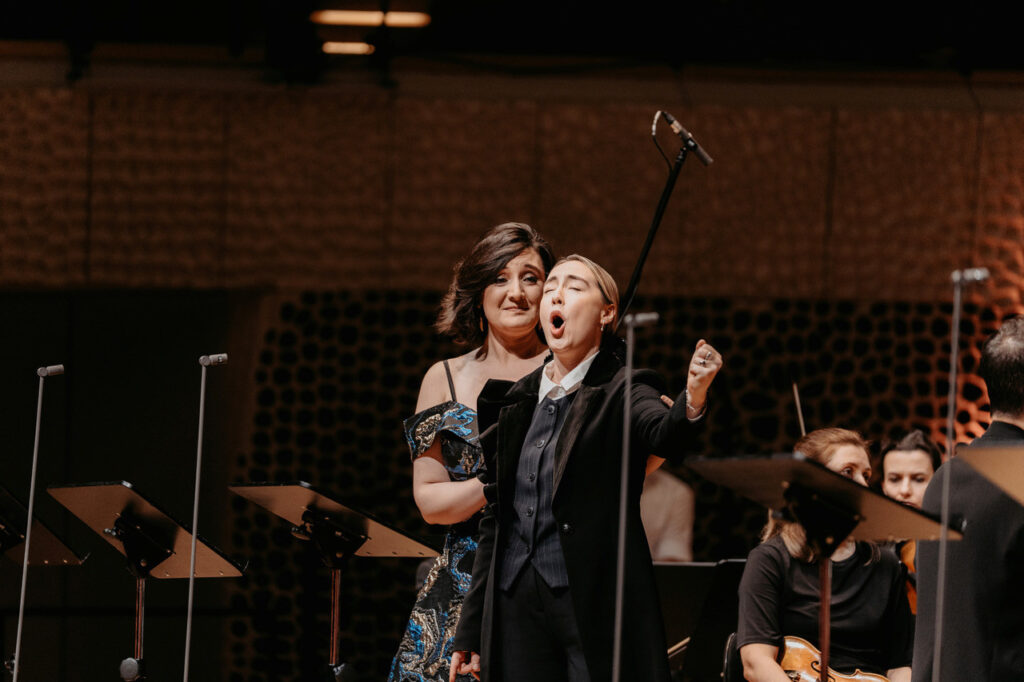
The title role was sung by Jakub Józef Orliński, who was in commanding form. Caesar needs to demonstrate constantly shifting emotions in order to establish the breadth of the characterisation. From his opening aria, Presti omai l’egizia terra, in which he displayed his credentials as soldier-hero, brimming with confidence and authority, through the rapid runs and complicated coloratura of his following aria, Empio, dirò, tu sei, togliti, Orliński sang with total assurance. Still only in his mid-thirties, his voice has clarity and brilliance, first-rate articulation, together with an evenness of line and beauty of tone which are at times quite breathtaking. I found some of his softer moments, such as the Act 3 duet with Cleopatra, Caro! Bella! Più amabile beltà, as impressive as his note of heroic defiance in confronting the threats from his declared enemies such as in his Act 2 aria, Al lampo dell’armi. Above all, his political integrity and humanity are woven into the fabric of the character: Tolomeo has dared to have executed one of Rome’s consuls in Pompey, and Caesar therefore needs to be seen as his avenging enemy.
Though he has sole top billing in this opera, Caesar is equalled by the figure of Cleopatra, who was reputedly a bewitching conversation partner, fluent in nine languages, as well as embodying all the erotic appeal of a young female ruler. In her first Act 1 aria, Non disperar; chi sa? Se al regno, Sandrine Piau kept the voice reined in, but was later to grow considerably in stature, with silvery notes to embellish the advice which she gives herself, namely not to despair at failure to secure the throne of the Ptolemies for she may well gain compensation in love. She took especial delight in the florid lines of Tutto può donna vezzosa, in which she reaffirmed that a beautiful woman, which historically she most certainly was, is capable of anything. By the time of her Act 2 aria, V’adoro pupille, in which Cleopatra sings of Cupid’s arrows bringing her closer to Caesar, she had settled somewhat vocally, always deploying her voice intelligently, calling upon the deities in her accompanied recitative, Che sento? Oh Dio!, to protect her beloved. In her subsequent aria, Se pietà di me non senti, which closes Act 2, she rose above herself, finding a high degree of passionate commitment to her cause and course of action. Having just realised that her brother Tolomeo wishes to see her utterly humiliated, her Act 3 aria, Piangerò la sorte mia, was a particular highlight, vowing that her own spirit will haunt him to the ends of his days, delivered with a deep sense of anguish supported by a single flute, theorbo and low strings.
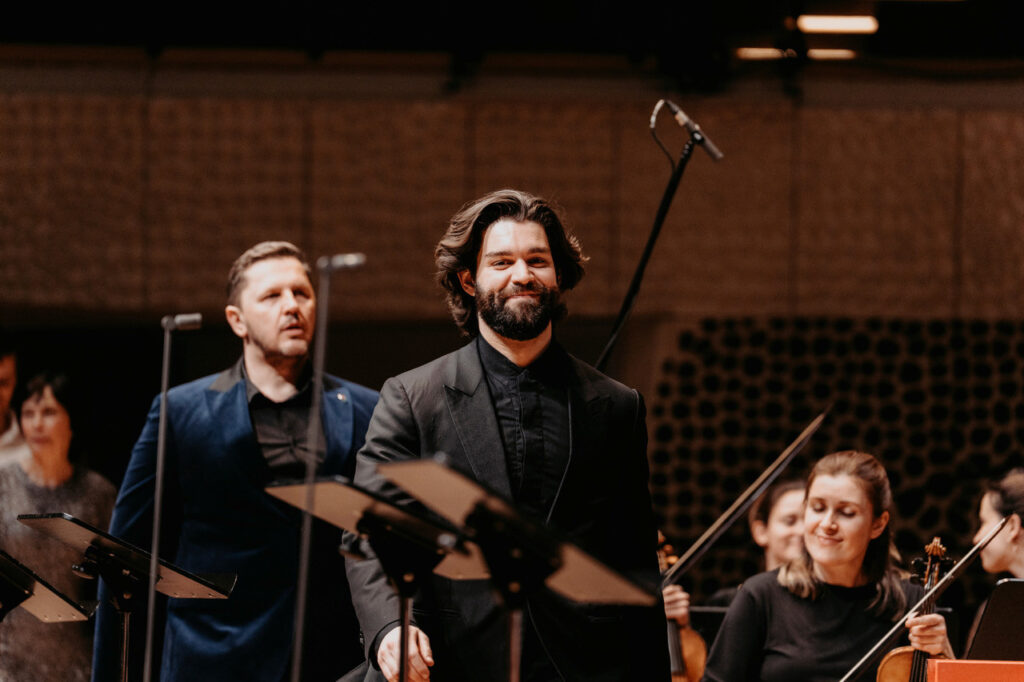
Beth Taylor’s career continues to go from strength to strength. She was ideally cast in the role of Cornelia, Pompey’s second wife and mother to her stepson Sesto, where her deep mezzo had sumptuousness and expressivity to match. Of all the singers she seemed to understand that a relatively static presentation of this opera demanded dramatic underpinning in terms of body language. She was as affecting in her exchanges with Sesto as she was in her loathing for Tolomeo, where her voice showed that she can spit and hiss as well as capture notes of pure caramel. Not the least of her wholly convincing characterisation was apparent in her final aria, Non ha più che temere quest’alma, in which her fearlessness and pride in the imperial designation of civis romanus sum were hurled with force at the duplicitous Tolomeo. Back then being a citizen of the Roman Empire mattered a lot.
Rebecca Leggett was an excellent Sesto. From her first Act 1 aria, Svegliatevi nel core, furie d’un alma offesa, right through to the point in her final aria, La giustizia ha già sull’arco, where her stepmother sees in her the heroic qualities embodied by her father, she displayed a lovely legato line imbued with strong feeling.
Tolomeo was in the hands of the Ukrainian countertenor Yuriy Mynenko. The voice itself was strong, both at the top and at the bottom of the range, lacking perhaps a little body in the middle, but there was an admirable degree of colouring. He found a malicious snarl for his Act 1 aria, L’empio, sleale, indegno,and was supremely cold and haughty in his exchanges with his sister Cleopatra in his Act 3 aria, Domerò la tua fierezza.
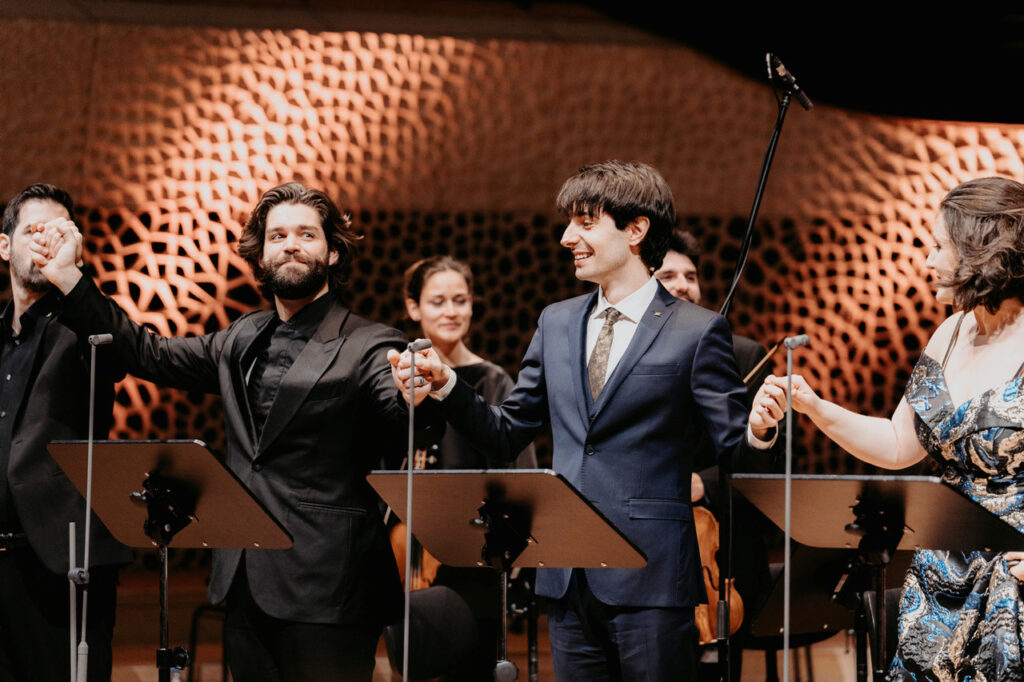
I very much liked the strong sootiness in the voice of Alex Rosen singing the part of Achilla, Tolomeo’s general, warm and secure, but with touches of malevolence which would not be out of place in the character of Iago. It is he who earlier in the opera points to the mesmerising quality of Cleopatra’s eyes.
The two remaining roles were well taken, Rémy Brès-Feuillet giving his role as Nireno qualities of a court-jester, attendant on both Cleopatra and Tolomeo, and Marco Saccardin as Caesar’s general Curio.
So, in this particular instance, Rome really did get what it wanted, as is usually the case with imperial powers. Caesar, with a wife in Rome and numerous affairs to his name including one with another queen, Eunoë of Mauretania, but prevented in Roman law from marrying a foreigner, gets the ultimate prize of Cleopatra, some thirty years his junior, celebrated in a cruise down the Nile accompanied by four hundred ships, not to mention passing on his DNA through Ptolemy Caesar, nicknamed Caesarion. But, as we all know, it didn’t end well for Julius. Beware the Ides of March!
Alexander Hall
Giulio Cesare in Egitto
Dramma per musica in three acts, HWV 17
Libretto by Nicola Francesco Haym
Music by George Frideric Handel
Giulio Cesare – Jakub Józef Orliński; Cleopatra – Sandrine Piau; Cornelia – Beth Taylor; Sesto – Rebecca Leggett; Tolomeo – Yuriy Mynenko; Achilla – Alex Rosen; Nireno – Rémy Brès-Feuillet; Curio – Marco Saccardin; Il Pomo d’Oro, Francesco Corti harpsichord and direction
Elbphilharmonie Grosser Saal, Hamburg, 12 February 2026
All photos © Sophie Wolter
Top Image: The cast of Giulio Cesare in Egitto