Songs my mother taught me: the title of the fourth in a cycle of gypsy songs by Dvořák, but this title also stands as a convenient coat hanger for so much of what babes in arms hear from their mother’s lips, including nursery rhymes and lullabies but, above all, folksongs. Every culture has them, for every culture has experiences of childhood. Central Europe in particular has proved to be a remarkable repository of such forms of musical expression. Bartók, born one year after Dvořák’s endearing composition, spent a significant part of his life collecting folk tunes, first in Hungary but then also from Romania, Bulgaria, Slovakia, Serbia and deep into the lands of Turks and Arabs. Today he is recognised as a co-founder of ethnomusicology. From Hungary alone came some 80 folksongs, mostly for voice and piano; five of these, described by Bartók as original compositions, albeit making use of old folk melodies, were premiered in 1933 in the form known as Five Hungarian Folksongs for Voice and Orchestra. Rarely performed, they opened the second half of this concert given by the London Symphony Orchestra under Sir Simon Rattle, with the mezzo-soprano Rinat Shaham as soloist.
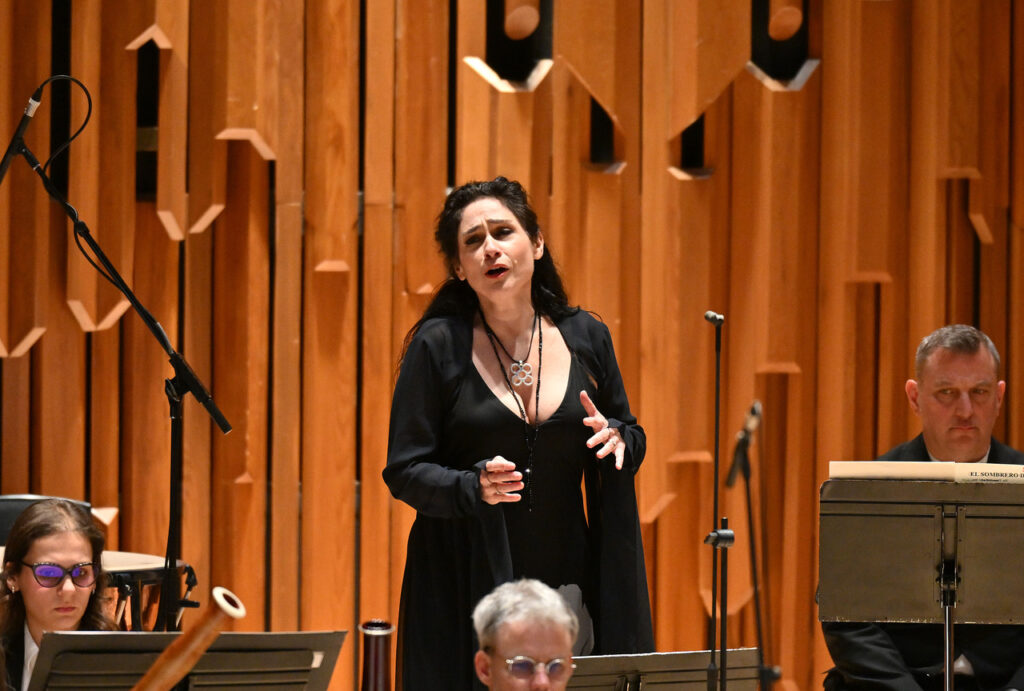
Anybody expecting a pastoral or idyllic mood to predominate, images of lambs gambolling in the fields and peasants dancing around a maypole, was in for a surprise. However, a familiarity with Dvořák’s tone poems shows just how grim and grisly fairy tales from this part of the world are. Taken from the collection Sad Songs, the first two of Bartók’s folksongs are no different. The titles represent the old adage of nomen est omen: A tömlöcben (In Prison) and Régi keserves (Old Lament). The words of that first song are enough to engender a nightmare. A man is incarcerated away from wife and children and left to languish in a state of utter hopelessness: “So my tears are falling down/Watering the ground with grieving/Tear-stained breast with sorrow heaving”. There were lots of falling phrases for the voice, Shaham’s dark colouring accentuating the gloom and turning the content into a dramatic monologue, the inkiness of the orchestral sounds highlighted by a bass clarinet towards the close.
Nor was there any relief in the second song. Here, the narrator is “orphaned and left alone” and identifies with a roadside bough, starting to wither until an end is glimpsed, “beneath black earth to lie”. Shaham’s delivery was strong and powerful, the articulation clear, even if there was a suspicion that those tricky Hungarian vowels weren’t quite idiomatic-sounding. The lament was underpinned by a suitably melancholic cor anglais. Despite pastoral elements at the start, the fourth song Panasz (Complaint) intensified the mood of sickness and suffering, attached to the image of a poor rose “ailing tremendously”, with only the prospect of a burden being shared with the narrator to alleviate the all-embracing misery.
I daresay Bartók’s intention was to represent the whole range of human experience. Without the comparative jollity of the third and fifth songs, however, this brief collection might have sent me into a depressive state. The love interest in the third song, Sárga csikó, csengö rajta (Yellow Pony, Harness Jingling), is focused on a lass called Róza Kocsis, and the pony’s progression towards the cottage where she lives is accentuated in the faster pace of the orchestral accompaniment, with keyboard percussion, triangle and flute contributing to the brighter mood. Shaham’s very expressive face for the final song, Virágéknál ég a világ (Virág’s Lamps Are Burning Brightly), plus her evident delight in the many onomatopoeic words, brought this short cycle to a perky close.
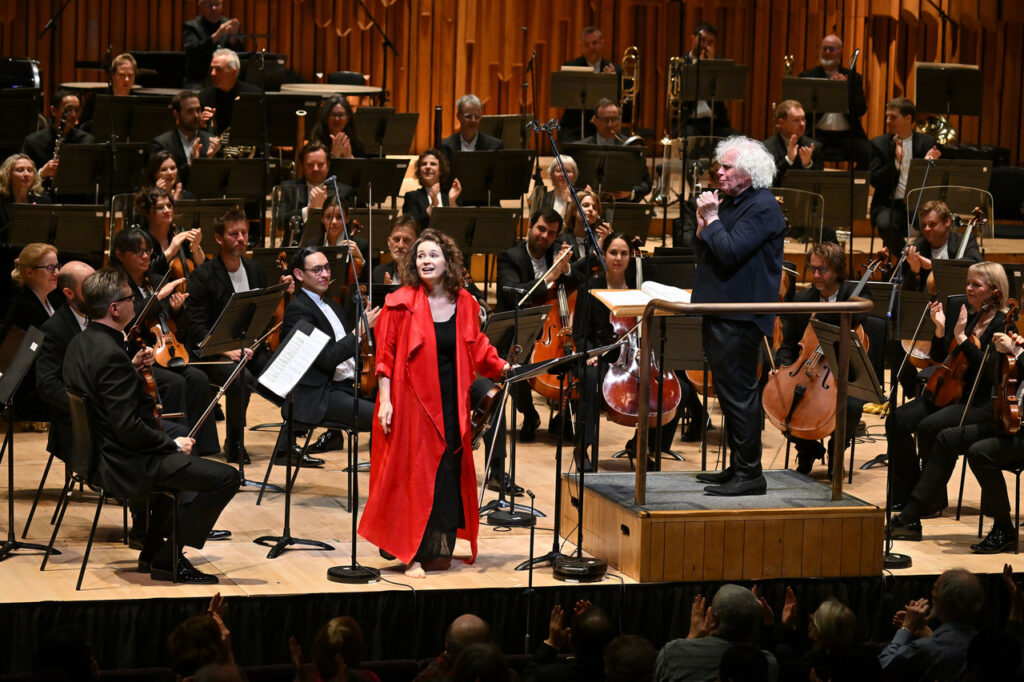
This concert offered the rare luxury of two soloists. The first half was taken up entirely with what has become known as Bartók’s Second Violin Concerto, though the composer had actually written another work for this instrument three decades earlier which was not, however, published until after his death. If you were looking to somebody to give a particularly theatrical performance of a work that is fiendishly difficult to play and involves fistfuls of notes plus ferocious double-stopping, you need look no further than Patricia Kopatchinskaja. She may be small of stature but she is mighty of presence. Looking at times like a cat waiting to pounce, she transformed her instrument into something much larger than a traditional fiddle, battering, massaging, stroking, tapping and teasing it, pulling it this way and that. At one stage her bow resembled a very sharp blade used to trim off all the fat. Throughout, Bartók drives his soloist to extremes. Yet his quicksilver temperament ensures that nothing stays exactly the same for more than ten seconds. What I took from this engrossing performance, superbly aided by the muscular and imaginative playing of the LSO under Rattle, was the way in which the violin often sounded not like a fiddle but the human voice: calling, groaning, pleading, rasping, sighing, whining, with elements of intermittent throat-clearing.
If the angularity and percussive quality of much of the writing contributes to a sense of untrammelled physical vigour, it’s the lyricism with plentiful traces of folksongs which helps to create a multi-dimensional experience in this work. PatKop was alive to all these sudden and subtle shifts in tempo and dynamics, applying balm where necessary to bruising textures. In particular, the central slow movement marked Andante tranquillo showcased the ghost-like music that Bartók was so fond of elsewhere, the orchestral string tremolos adding a deathly pallor, and the harp giving an idealised impression of a cimbalom, thus reinforcing the Hungarian flavour.
If there is fire and passion in the music of Bartók, this is equally true of de Falla’s compositions. It is his year: the 150th anniversary of his birth and the 80thanniversary of his death. So it was entirely fitting that Rattle and the superbly confident LSO should conclude this concert with the complete ballet of The Three-Cornered Hat. One of the many compositions intended for Diaghilev’s Ballets Russes, it had at its premiere costumes and sets designed by the young Picasso. The title is a reference to the local magistrate’s badge of office, and El Corregidor believes he is important enough to make free with any woman of his pleasing. In his arrogance, however, he is thwarted by the miller and his wife. The score bristles with high-voltage energy, myriad rhythmic inflections and tonal contrasts, featuring several characteristic Spanish dances such as the seguidilla. Just the kind of music you would expect this orchestra and this conductor to excel in.
This was very largely the case too. The piece opens with trumpets, drums and a rattle of castanets, and the spirited quality was heightened with the entire orchestra clapping and cheering, followed by a short narrative introduction delivered by Shaham from the very back of the platform, her Spanish now sounding much more idiomatic. It’s essentially an appeal to “Casadita” (darling) to bolt the door securely against the devil: El Corregidor may soon be on the prowl. In the collection of seventeen items that make up the complete ballet, there is a fetching role for an unaccompanied female voice in the Nocturno, “Por la noche canta el cuco” (At night the cuckoo sings), here strongly projected by Shaham.
This performance had all the earthiness and exuberance you might wish for, including the quite stunning, jaw-dropping precision of the LSO strings at speed, proud horn solos including a brief reference to Beethoven’s Fifth Symphony, and a bassoon passage that drew attention to the magistrate’s pomposity. What I did miss, however, was more of the sultry atmosphere typical of an Hispanic climate. Bags of excitement, to be sure, but not enough sensuousness and languorousness. The foot-stamping heroics were there in abundance, but what about the furtive looks, the sexy swish of a flamenco costume and all those sneaky, meaningful smiles? I suspect that the Barbican acoustics are just not made for such subtleties.
Alexander Hall
Bartók – Violin Concerto No. 2 Sz.112, BB 117; Bartók – Five Hungarian Folksongs; de Falla – Complete Ballet, The Three-Cornered Hat (El sombrero de tres picos)
Patricia Kopatchinskaya (violin); Rinat Shaham (mezzo-soprano); London Symphony Orchestra, conductor Sir Simon Rattle
Barbican Centre, London, 18 January 2026
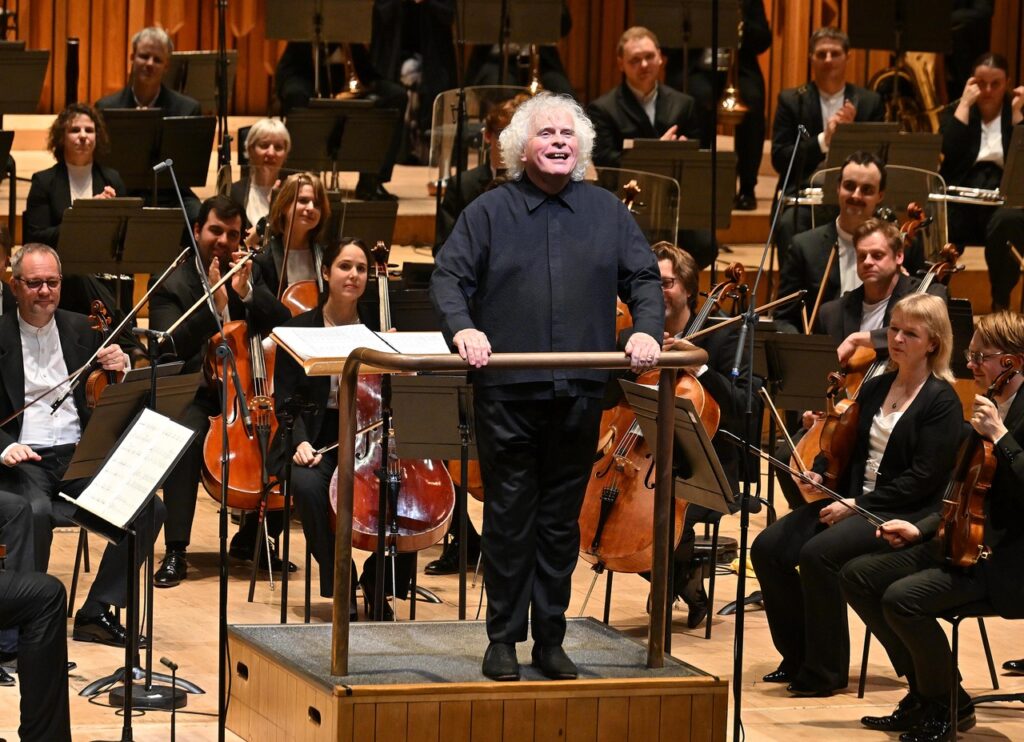
Top image: Sir Simon Rattle and the LSO
All photos © Mark Allan