Stagings of Bach Passions are, if not the norm, certainly not unknown; and Insula showed how effective known music with projection can be in Matt Collishaw’s Sky Burial, a film response to Fauré’s Requiem. Insula’s Brahms is pretty much an unknown quantity, except for their recording of Brahms’s orchestration of Schubert’s Gruppe aus Tartarus (on their Erato disc Nacht und Trãume, with Weibke Lehmkuhl). Even in that small piece, the benefits of Insula’s period instrument and period performance approach pay dividends in the attack and the clarity. The days of Klemperer’s upholstered (although undeniably powerful) Brahms are over. Plus, David Bobée’s interpretation is as contemporary as they come: we saw projected images of both Ukraine and Gaza, uncomfortably relevant and immediate.
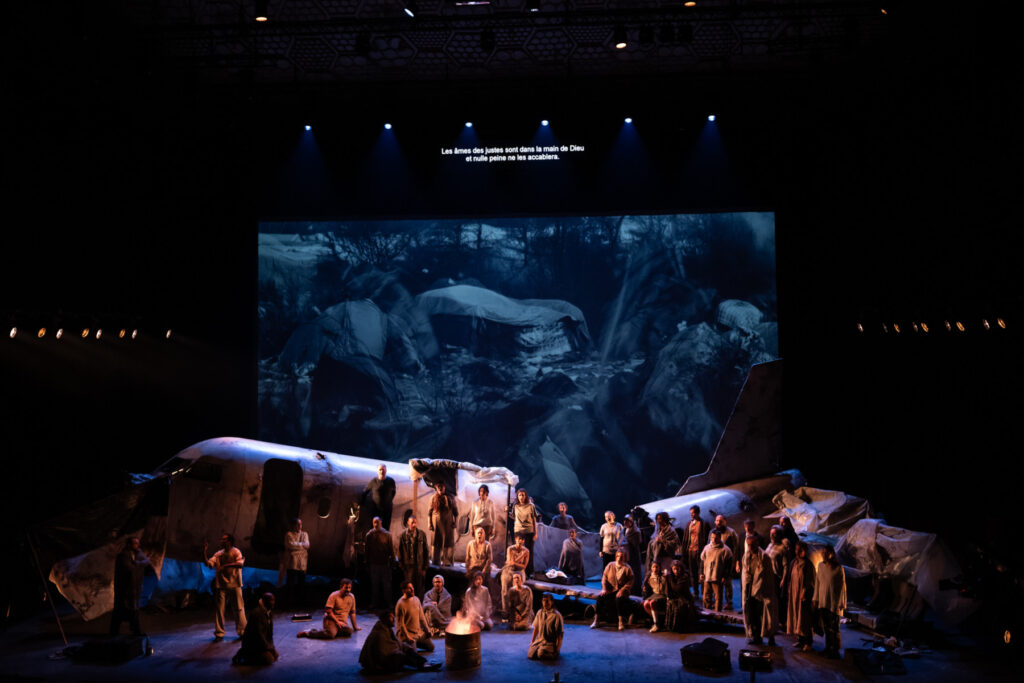
So instead of an hieratic Brahms Deutsches Requiem (or, as here, Un requiem allemand), Equilbey persuaded us this was as close as Brahms ever got to opera. The audience enters to the spectacle of a splintered aeroplane; we are privy to the (surprisingly many, given the state of the plane) survivors, now displaced wanderers: as are so many, after the disruptive events of war, Bobée seems to be saying. The linear revelations of the orchestra on period instruments were balanced by a sense of dramatic drive, nowhere more apparent than in the second movement, “Dann alles Fleisch ist wie das Gras”. The movement is predicated on growing tension; it was to Equilbey’s credit that the climax was as powerful as any. The suspensions in the wind against the choral resolution took on an acidic bite that cut straight to the heart. The opening “Selig sind” was of wonder, but also emaciation. As Bobée points out, Brahms’ German Requiem speaks both of life, and death, and of a “universal spirituality”. The crash survivors are a metaphor for “human failings and a world hurtling towards its downfall” (again, Bobée’s words). The human collective (the chorus) emerges from the debris. The kernel of the final hope is perhaps in the very act of survival itself, therefore, just as the seeds for redemption and peace exist in Brahms’s opening. Above all that is the hope for an ecological re-awakening for our planet (in this sense, it links to Insula’s Pastoral for the Planet of some years ago).
The journey from opening to end is not a mono-directional one, but the sudden arresting “Aber” (But) in the text seems a turning point, perhaps prepared by the “So seid nun geduldig”. Rarely can the cumulative energy of the second movement’s final fugue have held such power, a sort of contrapuntal behemoth on crack. Equilbey found beauty, too, in “Wie lieblich sind die Wohnungen”.

Complementing all this are a number of stage actions: a sign interpreter who takes the act to that of art form (Jules Turlet), an acrobat (Salvatore Cappello) who manoeuvres himself as Christ into the most astonishing levitating crucifixion high above the stage, and the equally staggering, and beautiful contorting dance of Yingyu Lyu, at times a contemporary dervish.
There are two protagonists in Brahms’s score, though; it is not just a choral collective. And they step forward appropriately: the astonishingly pure soprano of Eleanor Lyons, shot through with sadness at “Ihr habt nur Traurigkeit,” and the baritone John Brancy, whose petitions to “know his end” cut deep. There was perhaps a touch of weakness in the lower end of his voice, but the dramatic punch was all there.
The stars were, as so often, the singers of accentus, Equilbey’s super-choir that can do no wrong. Or almost no wrong; there was the odd touch of disagreement between stage and orchestra that will I am sure be ironed out as the performances continue. Bobée’s staging was realised by himself and Léa Jézéquel, while Mayuko Tsukiji and Samuel Bobée provided the survivors’ ragged costumes. It was Léo Courpotin’s lighting that added real atmosphere, though, while Wojtek Doroszuk’s command of the video element ensured the images made full impact.
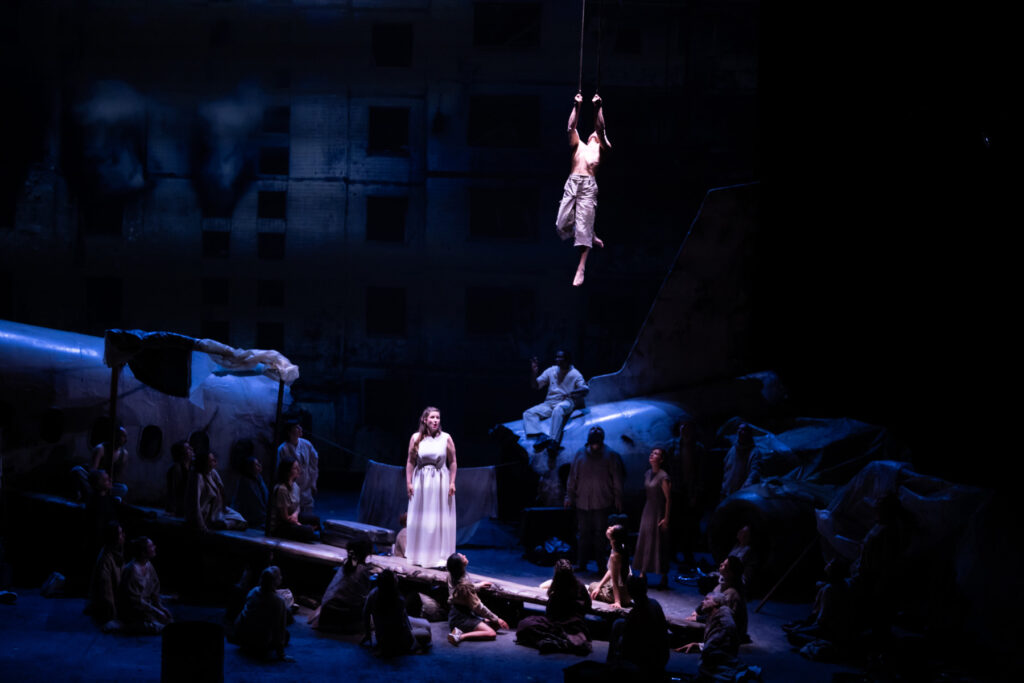
Cutting across all of this were inserts by Bach (from the Cantata, BWV 93, Wer nur den lieben Gott lâsst walten, Bach/Brahms O Traurigkeit, O Herzleid and O Welt ich muss dich lassen and Brahms’ own Wiegenlied and “Magdalena” from the choral Op. 22 Marienlieder). Far from exiting Brahms’s familiar requiem-trajectory, they enhanced it, humanising the text even further. The use of an accordion (Franck Krawczyk) was a masterstroke, taking us to the realms of folk music and nostalgia, and with it connecting to folk music’s links to the unconscious, this creating a sense of yearning and nostalgia that was unbearable.
So the final consolation? “Selig sind die Töten” (Blessed are the dead). But these are those that die “in the Lord,” and who may find rest. There is hope for all of us: the cradle song (incidentally heard, by this listener, the day after in Sabine Devieilhe and Mathieu Pordoy’s recital of a “Cycle berceuses” at the Wigmore) took on huge resonance as a metaphor for hope, of new life.
The Insula/accentus Deutsches Requiem lives on days after the performance in this listener, and surely will do for some time yet. It is one of those experiences that is so multi-layered, it surely must be experienced multiple times.
Colin Clarke
Ein deutsches Requiem, Op. 45
Composer: Johannes Brahms
Performers and Production:
Eleanor Lyons (soprano), John Brancy (baritone); Jules Turlet (signer/actor); Yingyu Lyu (dancer); Salvatore Cappello (acrobat); Franck Krawczyk (accordion); accentus; Insula Orchestra; Laurence Equilbey (conductor).
Director – David Bobée; Scenography – David Bobée, Léa Jézéquel; Costumes – Mayako Tsukiji, Samuel Bobée; Video – Wojtek Doroszuk; Lighting – Stéphane Babi, Aubert and Léo Coupotin; Sound – Jean-Noël Françoise.
La Seine Musicale, Paris, 13 January 2026
All photos © Julian Benhamou