“Leave alone, just leave alone, child. He who cannot, cannot. Not every memory becomes a story, and not every story can be reduced to words.”
It absolutely feels reductive to attempt to write about an opera that contains such a refrain. Nonetheless, one of the lessons one can take away from Baruch’s Silence as recently performed by the Muffled Voices Festival at the Maryland Theatre is this: that maintaining silence regarding trauma only leads to more trauma. Therefore, this story needs to be told, this work seen.
November 2025 saw the U.S. premiere of the opera by Ella Milch-Sherriff, based on the reconstructed 1943-1944 diary of her father, Dr. Baruch Milch. Along with her sister, she created the book Can Heaven Be Void? based on his testimony. Presented in German with English titles, I watched it on YouTube after the streaming premiere and was not disappointed in the least.
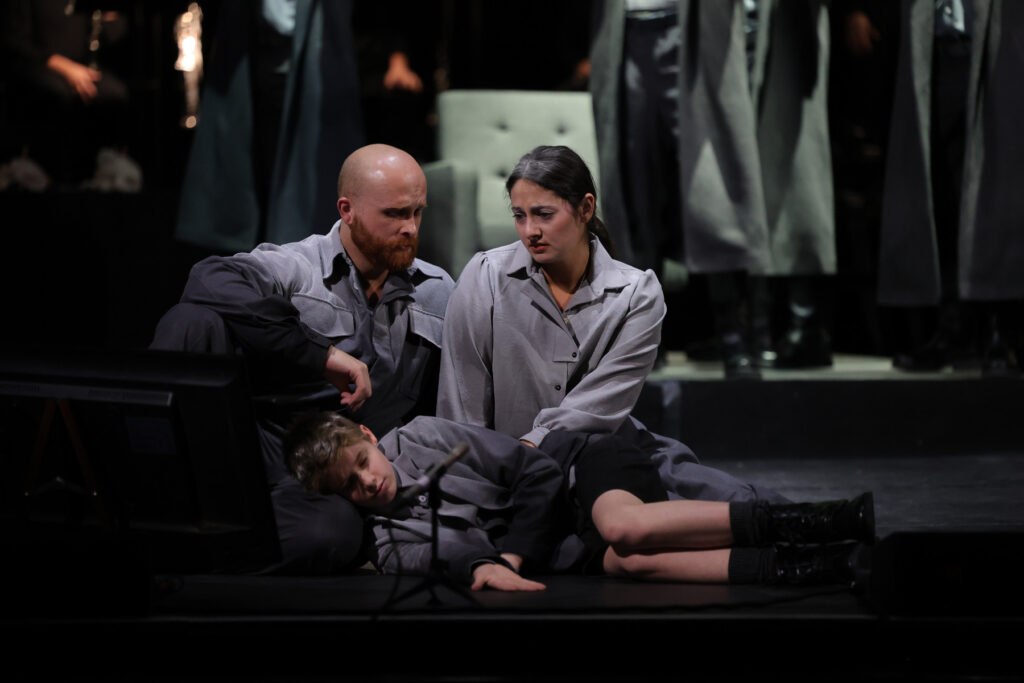
To begin with, the quality of video and audio production for the recording was gorgeous. There was great camerawork and editing. I felt like I could take in the whole stage, but the closer-up shots were effective, too, for example when the camera would focus on the ensemble in the background. Helping this was the minimalist set design by Julia Orlova and the top-notch chamber orchestra led by conductor Daiana Hoffmann. I am always impressed when a production places the orchestra behind the singers and no noticeable mishaps occur, and this was no exception.
The quality of the voices in the cast all around was also gorgeous. Hermine Haselböck as the Daughter brought a wonderful mezzo to her role. She executed excellent singing and acting, not just with her physicality by also with her diction. In some ways she played the part of the audience as her character discovered the story along with us, but more importantly, the character’s own story of experiencing coldness, harshness, and lack of affection from her parents illustrated brilliantly how trauma infects future generations of a family.
In the role of the Kid was boy soprano Kiril French. What a task and performance this young singing actor carried so well. Vocally, his performance was effective in its use of cold, straight tone, especially considering the nature of Dr. Baruch’s “ten commandments” (i.e. “Do not pray – Heaven is void) in his diary. I was impressed from his first appearance in the first scene.
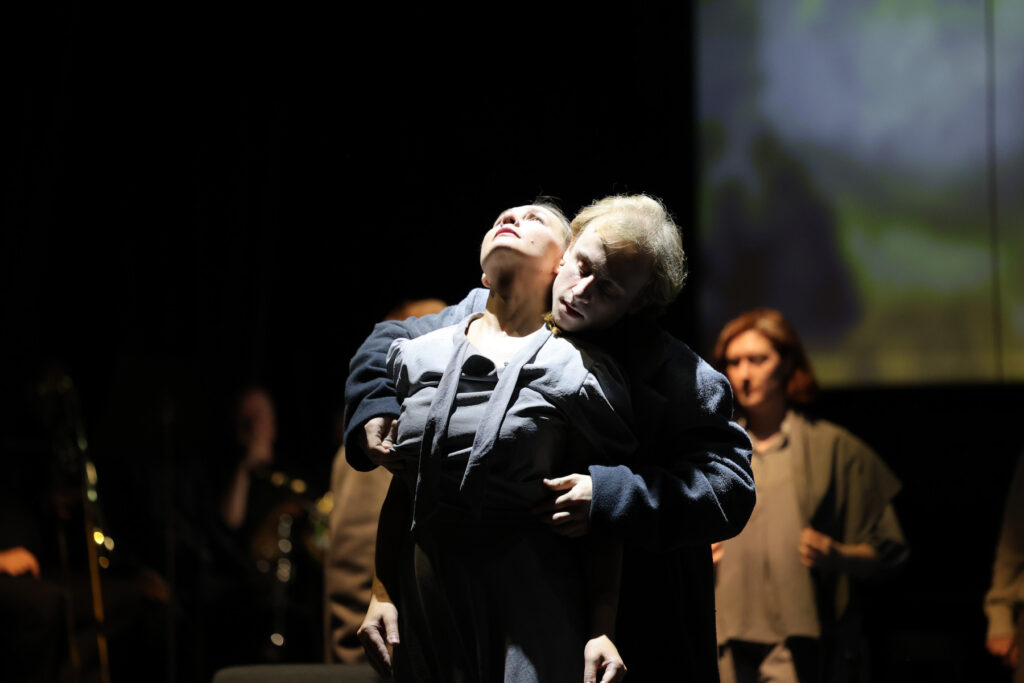
All I can say of Jonathan Patton in the role of Dr. Baruch is: YES. This baritone, always a pleasure to see and hear, in his character arc captured both moments of loud frustration and quiet resignation. Particularly memorable was his handling of singing with others. By way of example, his duet with the Kid in which he reveals that he had a first wife and child who were murdered during the Holocaust was appropriately jarring with the stark difference in their voices as they sang in octave intervals. The Kid turns out to be, in fact, Dr. Baruch’s murdered son, and the composer’s half-brother.
During Baruch’s diary entry about his life as a doctor, he sings about the misery he saw and the ensemble sings to him, asking him to cure their children of life. The Daughter sings about how she loved being sick because it was the only time she felt true affection, when her Father would treat her and hold her tenderly.
The First Wife, Baruch, and Kid try to escape. They know children were not shot by the Nazis but rather buried alive, and Baruch refuses to let that happen. Director Elizaveta Korneeva’s staging of this scene is cool to say the least. There was lots of the ensemble running around and tumbling onstage so that the audience really felt like they were trying to get away from something.
Baruch’s First Wife was played by Lauren Nash Silberstein, a glorious soprano. She sang a gorgeous lullaby to her son as they try to rest a bit during their escape. Here, too, was a wonderful moment of tenderness where Baruch joins in the lullaby. Alas, this peace does not last, as later while Baruch is away, he and his brother hear gunshots and explosions in the distance. Baruch notes how loud the silence afterward is, and we see powerful imagery of the Kid’s toy village being destroyed, and he and his mother covered with a shroud to represent their murders.
There is something approaching a sense of levity as the war ends and Baruch and his second wife, the composer’s mother played by Yulia Petrachuk, survive and find each other. Their duet is powerful, with them deciding to keep living together, and tragically, keep silence. This elicits a question from their daughter as to what trauma her mother endured. Her story gets told with the help of Alex Wiebe as the Grandmother, who brings a genuine joy to her role. She urges her daughter to go along with the desires of a Russian officer they encounter, played imposingly by bass Andrew Boisvert. At this point, he and Wiebe sing a duet in Russian together, and I have to give the cast kudos for those of whom it was asked to switch between German, Russian, and even Ukrainian later on.
As the Mother accepts the Russian officer’s lurid advances, eerie echoes of Wagner’s Bridal March can be heard in the orchestra. The implication seemed to be that the Mother was, in fact, raped, and that she felt that she had to do what the officer wanted. Unhelpful in this situation is the Grandmother’s merciless assertion that the Mother should be grateful to be alive. What does it matter what she has to do, if it means they survive? Meanwhile, Petrachuk’s voice shines as a powerhouse in this scene. She has incredible range and an ability to easily jump between low and high, which allowed the audience to hear and feel the character’s pain.
After understanding what the Mother went through, the Daughter wonders why neither Father nor Mother could find comfort, since they were not guilty of anything. At the same time, Baruch wonders why he alone survived. His Brother, sung by amazing tenor Nathan Schafer, tries to comfort him. It is ultimately revealed that, by standing by and doing nothing, while hiding out with a Ukrainian farmer, Dr. Baruch allowed his own brother’s child to be strangled to death. Patton’s singing here is, again, powerful. You could really feel the character’s guilt, and indeed, he wrote that he ceased to be a human being on that day. In the end, Daughter sits apart from Father onstage, and she is able to forgive him because she has borne witness to and now understands him and his trauma.
May the memories of those who perished in the Holocaust be a blessing, and may we not interweave “silence in silence, secret in secret” as the libretto says. You can help break the silence and honor the memory of the victims by watching the recording of this opera on the Muffled Voices Festival’s YouTube channel.
Maggie Ramsey
Baruch’s Silence
Composed by Ella Milch-Sheriff
Libretto by Yael Ronen
Cast and Production Staff:
Father – Jonathan Patton; Mother – Yulia Petrachuk; Daughter – Hermine Haselböck; First Wife/Ukrainian Girl – Lauren Nash Silberstein; Grandmother/Mrs. B – Alexandra Wiebe; Brother – Nathan Schafer; Russian Officer/Mr. B – Andrew Boisvert; Kid – Kiril French; Supernumeraries – Ivan Markov, Justin Meyer, Joshua Cole Lucas
Muffled Voices Festival Chamber Orchestra. Producer and Art Director – Yulia Petrachuk; Stage Director – Elizaveta Korneeva; Music Director & Conductor – Daiana Hoffmann; Set & Costume Designer – Julia Orlova; Production Manager – Olga Orfinadi; Light Designer & Tech Director – Boris Kartashev
The Maryland Theatre, Hagerstown, MD, November 22, 2025
Top image: (L to R) Father (Jonathan Patton), Kid (Kiril French), Daughter (Hermine Haselböck), Mother (Yulia Petrachuk)
All photos by Anthony Nguyen