The New National Theatre Tokyo ushered in the year with the seventh revival of Heinz Zednik’s celebrated 2006 production of Die Fledermaus. At the 24 January matinée, the auditorium shimmered with guests in traditional kimonos, lending a uniquely festive elegance to the afternoon. One can only admire their fortitude; enduring four hours in the restrictive grip of such formal attire is no mean feat of stamina.
First presented in Vienna in 1874, Die Fledermaus remains Johann Strauss II’s most enduring stage work. The plot is a quintessential Viennese trifle of deception and champagne-soaked revenge. Diverted from a pending prison sentence by the scheming Dr Falke, the prosperous yet bumbling Eisenstein escapes to Prince Orlofsky’s ball. There, he becomes entangled in a web of masked flirtations – most notably with his own wife, Rosalinde, masquerading as a Hungarian countess. It is a whirlwind of contrived identities that dissolves into a chorus of light-hearted absolution by the third act, with the ‘King of Wines’ conveniently taking the blame for every indiscretion.
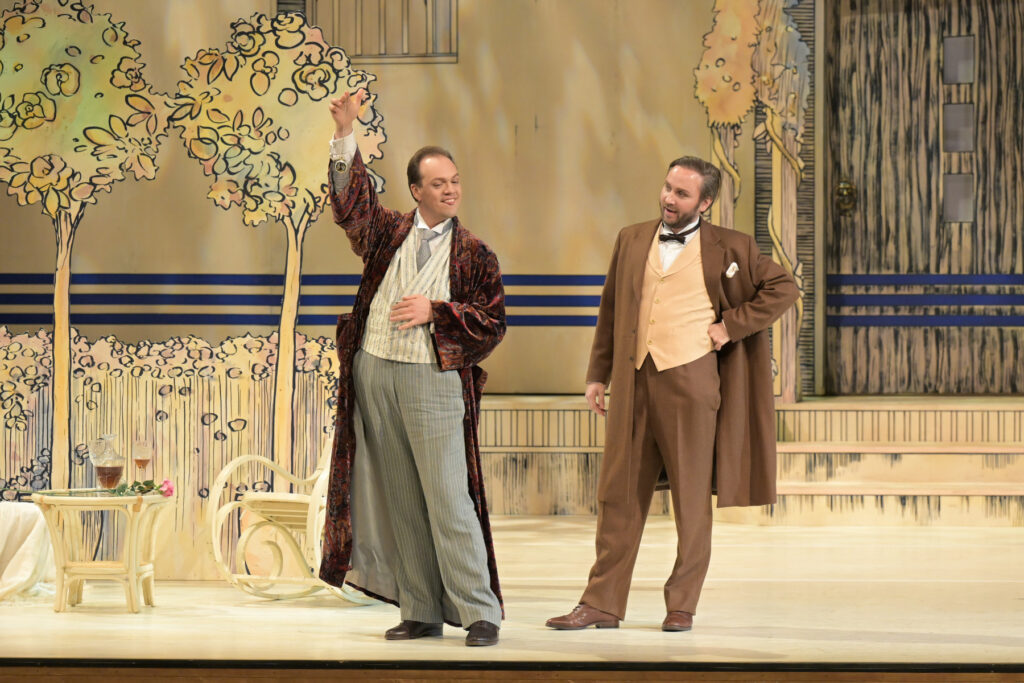
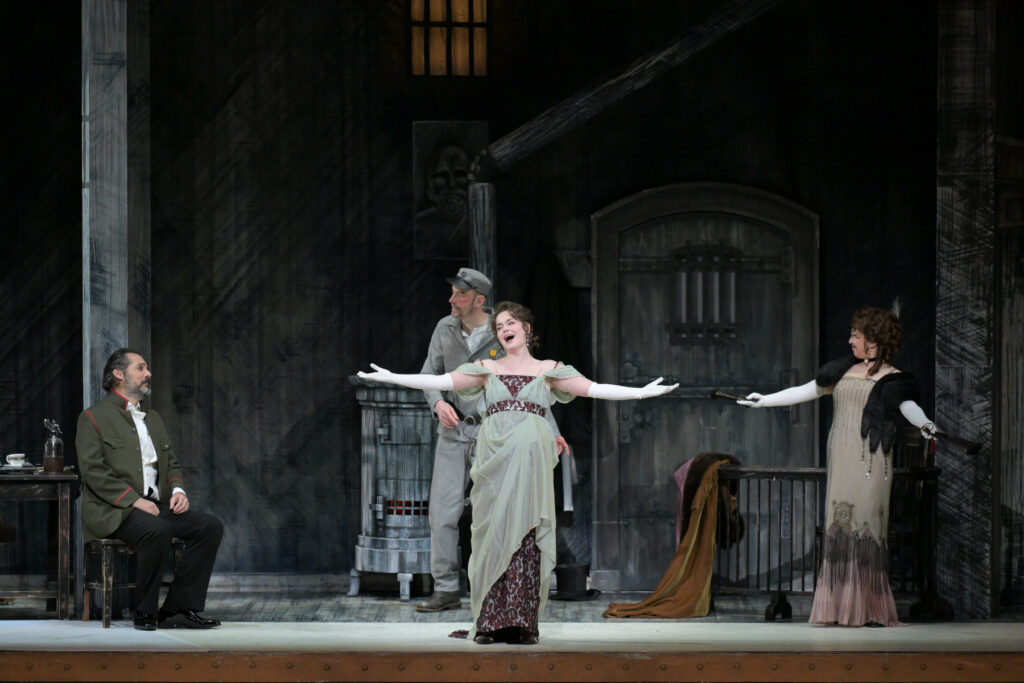
Zednik’s vision involves a refined aesthetic influenced by Japonisme. Olaf Zombeck’s set and costume designs, inspired by Jugendstil, are exquisite, featuring flowing curves and botanical motifs in a chic palette of gold and muted blues. The subtle asymmetry of the staging adds visual intrigue, with the drama unfolding within an elegant proscenium frame. This sophisticated atmosphere – complemented by the cast’s stylish mannerisms – perfectly captures the spirit of the score. Most striking was the denouement; as the revenge plot reached its climax, the scene shifted in an instant from the grim prison office back to the opulence of the ballroom – a transition of breathtaking fluidity.
The musical delivery was exceptional. As Eisenstein, Belgian tenor Thomas Blondelle was strikingly agile, both vocally and physically, marking a triumphant house debut. His regal wife, Rosalinde, was superbly portrayed by Slovenian soprano Sabina Cvilak, who displayed a metallic lustre in her upper register and a mellow, sensuous middle range. Her Csárdás in Act II was a genuine show-stopper. Adele, her maidservant, was charmingly played by Belarusian soprano Maria Chabounia, another formidable NNTT debutant. She embodied the quintessential soubrette with admirable poise, never descending into caricature. Her ‘Mein Herr Marquis’ was delivered with a soft, uncommonly elastic voice that was simply delicious.
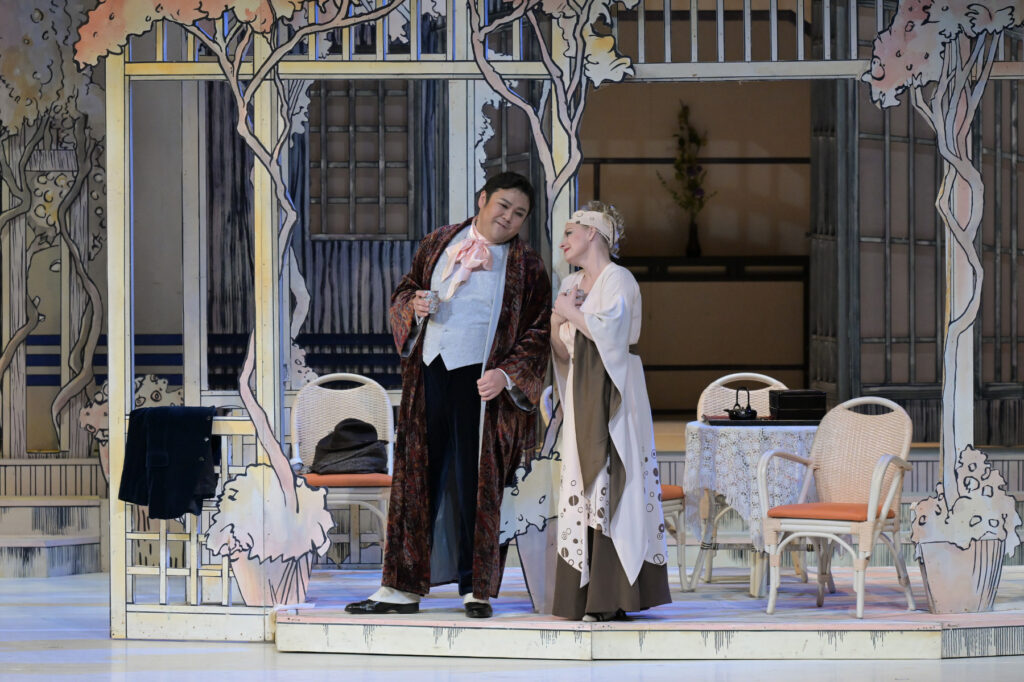
As Dr Falke, ‘the bat’, Austrian baritone Rafael Fingerlos also made his first appearance on the NNTT stage, captivating the audience with his rich tonal warmth and conspiratorial charisma. Frank, the prison governor, was sympathetically rendered by Turkish baritone Levent Bakirci, rounding out a stellar group of newcomers. The role of Prince Orlofsky has a distinguished history in this production, previously graced by the likes of Elisabeth Kulman and Aigul Akhmetshina; on this occasion, Japanese counter-tenor Daichi Fujiki took the stage, adding a compellingly androgynous allure to the ambiguous role.
As Alfred, Rosalinde’s former lover, Japanese tenor Tatsundo Ito shone with a bright, dynamic energy. In a witty departure from the original libretto – where Rosalinde fears she cannot resist his ‘high B’ (vor seinem hohen B schmilzt meine Kraft dahin!) – she instead swooned over ‘the thrill of a Japanese tenor’, eliciting instant laughter. This local colour was woven effectively throughout. In Act I, the request for sushi and sake culminated in Adele presenting a stunning lacquered jubako (tiered box) – a clever, seasonal nod to the traditional osechi feast. Meanwhile, the New National Theatre Chorus was in fine form, singing with robust, unified power.
Underpinning these delights was the Tokyo Symphony Orchestra, led by Daniel Cohen. The score was delivered with the requisite effervescence, the conductor navigating the Overture’s brisk transitions with precision and ensuring the waltzes possessed that essential, lingering Viennese lilt. This seventh revival proves that Zednik’s production remains as vital as ever – a sophisticated, heart-warming start to the year that beautifully honours both its Austrian roots and its Japanese home.
A Note on Etiquette: Regrettably, the second act was spoilt for this reviewer by the belated arrival of a heavily perfumed member of the audience who took the neighbouring seat. Such an olfactory assault, which left me feeling quite ill, was a poignant reminder that consideration for the shared environment remains the final frontier of theatre etiquette. That said, the experience was salvaged by an exemplary NNTT front-of-house team.
Natsuko Hirakura
Die Fledermaus
Composed by Johann Strauss II
Libretto by Karl Haffner and Richard Genée
Cast and Production Staff:
Gabriel von Eisenstein – Thomas BLONDELLE; Rosalinde – Sabina CVILAK; Frank – Levent BAKIRCI; Prinz Orlofsky – FUJIKI Daichi; Alfred – ITO Tatsundo; Dr Falke – Rafael FINGERLOS: Adele – Maria CHABOUNIA; Dr Blind – AOCHI Hideyuki; Frosch – Horst LAMNEK; Ida – KONNO Sachie
Director – Heinz ZEDNIK; Set and Costume Designer – Olaf ZOMBECK; Choreographer – Maria Luise JASKA; Lighting Design – TATSUTA Yuji; Tokyo Symphony Orchestra and New National Theatre Chorus, Conductor – Daniel COHEN
New National Theatre Tokyo, 24 January 2026
All photos © Takashi Shikama