Relocation, relocation, relocation: Coney Island, Booklyn, is a long way from the Bay of Naples. But such is the setting for Phelim McDermott’s Cosi fan tutte; or is that Cosi fan tutti? The latter appears late in the opera on one of the many boards: the change from feminine plural (all women are the same) to a more ambiguous masculine plural/all-embracing plural (‘tutti’) implies everyone is ‘like that’.
The garish nature of the all-the-fun-of-the-fair production is very deliberate. The setting is 1950’s Coney Island (costumes and hairstyles brilliantly done by Laura Hopkins); a Ferris wheel suggests the circular nature of the shenanigans in this ‘school for lovers’ (nothing has surely changed since, surely), while a roller-coaster is self-explanatory. Attending the matinée on Valentine’s Day seemed just perfect … I wonder if the opera held up a mirror to anyone in the audience? … statistically, surely the answer is yes. I also wonder if the neon sign for the “Skyline Motel” is deliberately phallic? This being an opera about temptation and its pitfalls, probably.
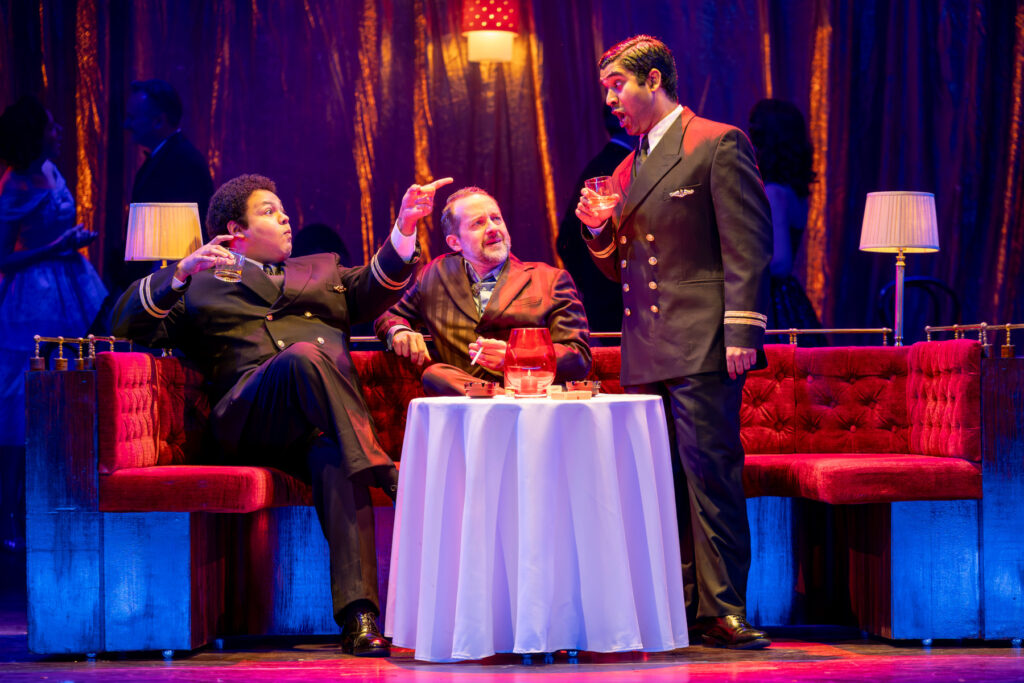
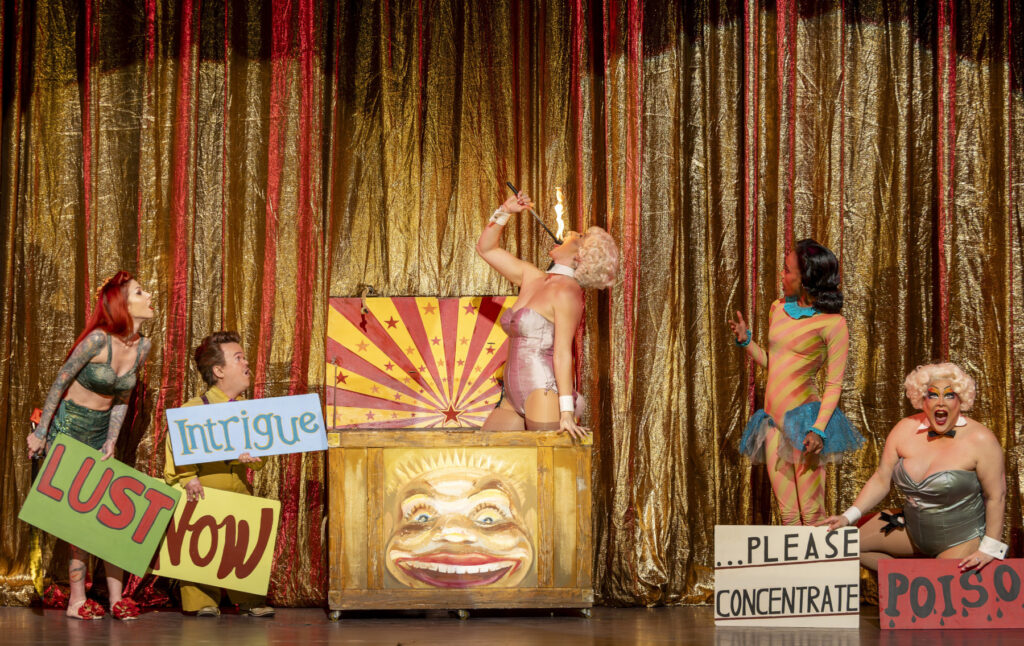
The presence of Improbable ensemble certainly ensured McDermott’s vision is followed through: extra-bendy, extra-tall and extra-small people, plus mandatory fire-eater and sword-swallower all contributed to the vision. Everything is larger than life, and garish thanks to Tom Pye’s sets: there are even some Mad Hatter teacups. The central tale isn’t changed though, the ladies are, shall we say, susceptible to change (one more so than the other, in fairness), but instead of returning as Albanians, Ferrando and Guglilmo return all slicked-up hair and leather jacket, the very definition of ‘greaser’. And instead of Mesmerism and the “Doctor”’s magnetic therapy, we have a decidedly Steampunk gyroscopic device. Not to mention plastic swans, perhaps Lohengrin’s cast-offs, and of disturbingly intimidating stare when viewed head-on.
There is always a danger that relocation (of place and/or era, here both) can detract from the depth of the opera, and that is somewhat the case here. Mozart’s music survives, of course; but sometimes there is so much fairground activity going on that it detracts, not least in the Overture, where circus performers emerge magically from a box and hold cards indicating (mainly) central themes: Lies, Love, Poison, Chocolate.
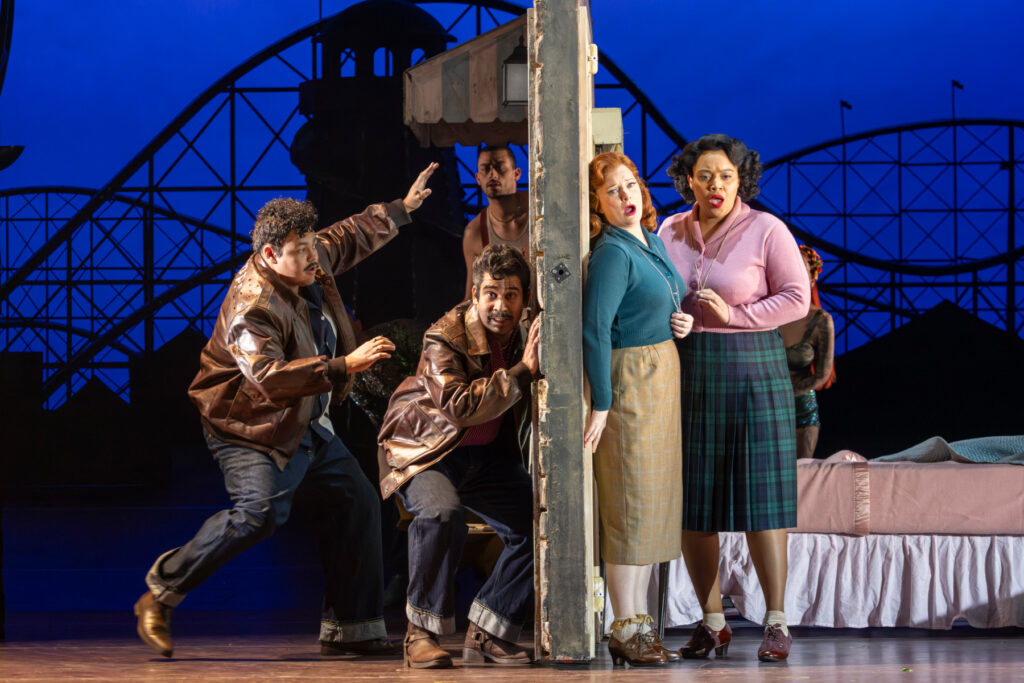
And as for the ‘skills ensemble’ of Improbable: they are very ‘present’ in this production, crowding around Don Alfonso, his ‘other’ accomplices (as well as Despina, of course). The 12-stong cast of ‘extras’ excelled, of course: they never do otherwise. But it is this deployment I question, dramatically cogent for the conception for sure, but when one considers how beautifully Improbable fitted into Glass’s operas Satyagraha and Akhnaten, this feels a little bit ‘less than’. Not quite a square peg in a round hole, more a misplaced round hole.
When I last saw this production of Cosi, in 2022, it was beleaguered by some lacklustre conducting (then, Karem Hasan). Not so on this occasion: Dinis Souza shows himself as a fine-eared Mozartian, detail consistently honoured and tempos always seemingly perfect throughout. Souza seems to know exactly how to get the maximum from his singers without sacrificing diction. The ENO orchestra clearly loves him, too, with some phenomenal woodwind contributions (and some nimble horn playing) and strings sounding better than I have heard in a while. Watching him from five rows back, his knowledge of the score is complete, his connection with his players both in gesture (a very eloquent beat) and via eyes never fails. And how they trust him.
So to the cast. The two engines of the plot – Don Alfonso and the maid, Despina – were characterfully taken. Don Alfonso was sung by Andrew Foster-Williams, of fine stage presence and, as with everyone in this cast, possessed of fine diction (I hardly had to glance upwards, surtitle-wards, all night). Foster-Williams was just as enjoyable to watch and to listen to as Neal Davies in 2022; it becomes interesting when one compares the maids. Two very different takes, Soraya Mafi perhaps the ideal Despina and possessed of a multiplicity of accents. This Despina was definitely Irish (and in both accent and looks, Ailish Tynan – could this be deliberate? – bears a strong resemblance to Maggie Driscoll, played by Pauline McLynn, current matriarchal incumbent of the Rover’s Return in Coronation Street). Tynan is funny and involving, to be sure, while the Irishness makes this Despina just a little more down-to-earth than usual. An interesting take.
There is no doubt the four singers making up the two (swapping) couples are cast from strength, too. Prima inter pares is Lucy Crowe as Fiordiligi, her voice so perfectly pure, her tuning impeccable, her acting matching this excellence, her ‘Come scoglio’ brilliantly resolute (and virtuoso in delivery). It was so good to have a strong tenor against her: Joshua Blue (who appeared in Bohème last season) has a voice that is not only strong but beautiful and true, too, his ‘Un aura amorosa’ (literally, ‘a tender breath,’ here, ‘voice of an angel’) a real highlight of the evening, beautifully supported by Souza and his players. While I found his Rodolfo Bohème took time to settle, there were no such concerns here.
The Dorabella was American mezzo Taylor Raven, making her ENO debut. Perhaps less than 100% sure all of the time, she nevertheless possesses a warmth of tone that offered good contrast to Crowe, while owning the different character of Dorabella. Darwin Prakash (a member of Staatsoper Hannover since 2022) took Guglilemo with aplomb; his voice is velvety while staying within Mozart’s orbit. Whoever cast this knew what they were doing: every pairing (Mozart obviously plays with his!) worked spectacularly well, as did the larger ensembles.
While my reactions to this staging are less negative than first time around, it still feels off-the-mark, clever but not deep. And Mozart’s music is always profound; it will always survive, too, as it did so beautifully here. Dinis Souza’s star is most definitely in the ascendent these days. Go see why.
Colin Clarke
Cosį fan tutte
Composer: Wolfgang Amadeus Mozart
Libretto: Lorenzo da Ponte (transl. Jeremy Sams)
(sung in English, Bärenreiter edition)
Cast and production staff:
Fiordiligi – Lucy Crowe; Dorabella – Taylor Raven; Ferrando – Joshua Blue; Guglielmo – Dawin Prakash; Don Alfonso – Andrew Foster-Williams; Despina – Ailish Tynan
Director – Phelim McDermott; Associate Director – Peter Relton; Set Designer – Tom Pye; Costume Designer – Laura Hopkins; Lighting Designer – Paul Constable; Revival Lighting Designer – Gary James; Revival Skills and Movement Director – Ishkandar R. Sharazuddin; Conductor – Dinis Souza.
London Coliseum, London, 14 February 2026
Top image: Andrew Foster-Williams and Skills Ensemble
All photos © James Glossop