From even the last phase of his life, on his return to Europe from the USA, Korngold has tended to be ignored as a not very serious composer, a late relic of Romanticism during the era of musical Modernism; and worse, a sell out to the American film industry by writing scores for the silver screen. Interest in his work has grown in recent decades with more recordings and biographies. But it’s not widely recognised outside of German-speaking countries that there are a handful of operas aside from Die tote Stadt (which itself doesn’t see the light of the stage too often, beyond ‘Marietta’s Lied’).
The Opéra national du Rhin (with its presence in both Strasbourg and Mulhouse) has led the way in France with the first production there of that opera in 2001, and now the first of Das Wunder der Heliane (1927), a joint production with Nederlandse Reisopera who first mounted it in 2023. The libretto adapts a modern mystery play by the short-lived writer Hans Kaltneker, in which the title character falls in love with the enigmatic Stranger, whose Christ-like message of love has stirred up the people, to the consternation of her husband, the Ruler. She visits the Stranger in prison, and is persuaded to bare herself to him to the point of physical nudity, but she holds back from physically consummating their passion. When the Ruler discovers them, thinking she has committed adultery, she is put on trial. The Stranger kills himself to preserve her honour, but at the trial Heliane is urged to use her miraculous powers to restore him to life, to testify that she wasn’t unfaithful. The spell works, but the Ruler kills her in a fit of jealousy, prompting the Stranger to raise her with himself to an eternal realm of everlasting love.
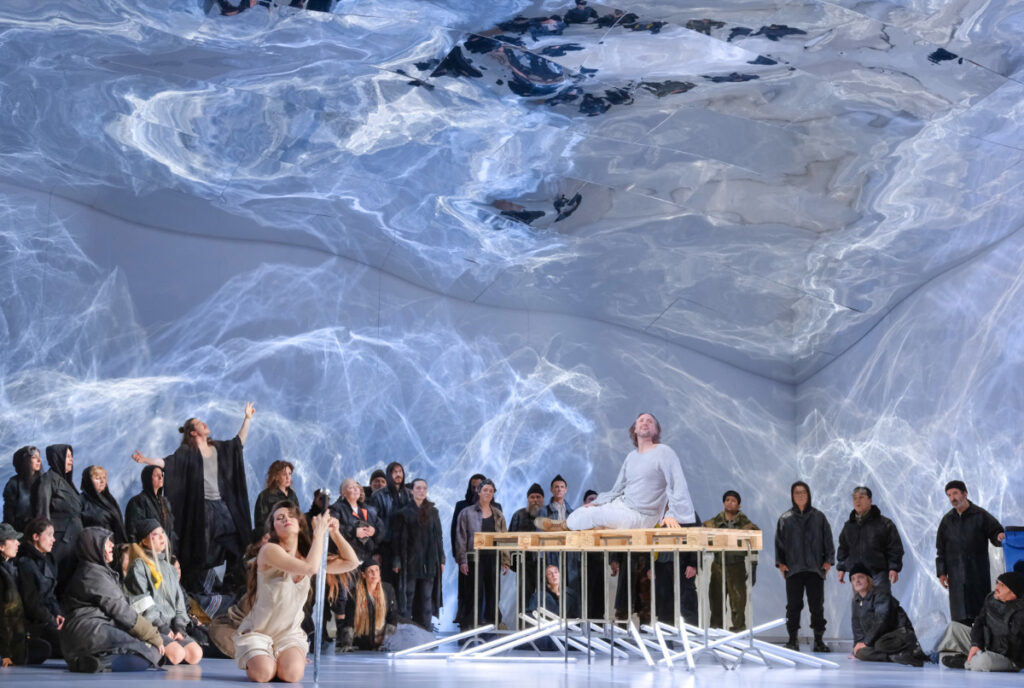
The quasi-religious drama of physical, erotic passion being transcended by a selfless, calmer love is reminiscent of Parsifal. But the story of a supposedly forbidden liaison and the tensions which result, around which most of the opera revolves rather than any ethical or philosophical musing, is more like Tristan und Isolde; or Heliane’s fascination with the Stranger is akin to Salome’s with the prophet Jochanaan. If Korngold’s score is a late instance of musical Romanticism, the opera’s narrative is a belated tale of fin-de-siecle Decadence, a heady mixture of religion and eroticism, composed not so long after Strauss’s opera, as well as the not dissimilar Le Martyre de saint Sébastien by D’Annunzio, with incidental music by Debussy. The conjunction of sex and religion here is emphasised in Guido Petzold’s designs with the projections onto the set which tellingly parallel the situations of the two central characters – the image of Hedy Lamarr from Gustav Machatý’s film Ecstasy with Heliane, nakedly and alluringly floating on the water, alive but presumably also with a knowing, tragic nod towards the example of Ophelia, in the famous painting by Millais; and the recumbent figure of a deceased man for the Stranger, itself evoking Andrea Mantegna’s remarkable painting Lamentation of Christ, showing the dead body of Christ in foreshortened perspective from the feet. In some sense, the transcendence of their physical love towards a more abstracted one, via the fatal wounds they have received, are regarded in the opera as morally transforming the people, like Christ’s sacrifice. The sort of love they herald falls roughly in line with the Christian idea of agape, the love rendered in the older English of the Authorised Version of the Bible as ‘charity’ – a more extensive and dynamic concept than the more limited one denoted by the modern English use of that word. (Certainly let’s forget JD Vance’s quack theological commentary on the ranks or ‘orders of love’ he chauvinistically interprets the Christian ethic to be.)
Jakob Peters-Messer’s programme note indicates that he was inspired to stage the work by Christof Loy’s production for Deutsche Oper in 2018, and something of that director’s style seems to rub off on this interpretation. Despite the background of mysticism and metaphysics, the opera plays out like many of Loy’s interpretations, as a this-worldly, domestic bourgeois drama in a sullen, grey space, like a prison, which remains for all three Acts, without much sense of even a physical world beyond, never mind a spiritual or at least moral one. We see, as it were, the ‘banality of evil’. The added silent extra of the Angel is a decidedly embodied entity, not otherworldly, choreographed and danced by Nicole van den Berg, as though the Stranger’s alter ego – or possibly that of the Stranger-and-Heliane (Tristan-esque shades of the discussion of the word und) – expressing its desire for freedom from its present constrained circumstances.
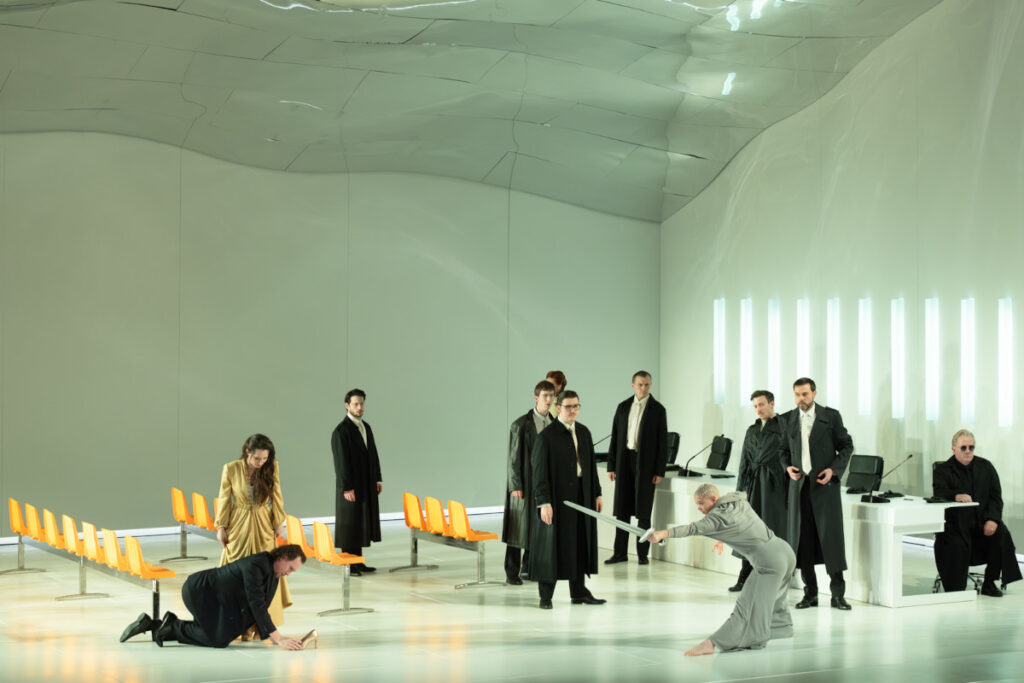
The crowd which is stirred up against the Ruler’s oppressive rule does appear, as so many figures from any contemporary urban society. But the sense of dystopia is essentially aestheticized here, rather than directed to any specific place or time (and goodness knows there are any number of places to which that tyranny could be related right now). Peters-Messer’s directing of the opera’s moral towards our everyday world, rather than a different, ideal one, partly chimes in with what seems to be the libretto’s own indecision as to whether its message is the redemption of this world or, instead, its transformation into, or the creation of, a wholly new one. Wherever it is that the Stranger and Helian go, they seem to go by themselves, leaving the crowd for their part to hail more immediate, comfortable bourgeois ideals as ‘freedom’ (Freiheit), and however one may render Glück in the original German text – even if the usual translation of ‘luck’ or ‘happiness’ sound too glib for what is meant, it is nevertheless a cosily domestic notion, rather than a challengingly metaphysical one. The crowd are no further forwards than the ‘freedom’ of Fidelio or Guillaume Tell of a hundred years or more before.
As if to forestall any unfashionably spiritual or transcendental spin on the Stranger and Heliane’s fate, the prison space of the set cracks open to reveal a façade of silvery tassels, glitzy but neutral, as though Peters-Messers says with a wry smile, that what they proceed to is a mirage, like a disco or realm of superficial glare. If I’m wrong or unfair about what he intends, I certainly don’t mean to disparage the directorial and visual strategy which has prepared for that opening up, with the shiny, wavy surface of the prison’s mirror-tile ceiling: its reflectiveness points suggestively and ambiguously to another, appealing space to rise into, but which may also simply be an illusion or a replication of what already exists.
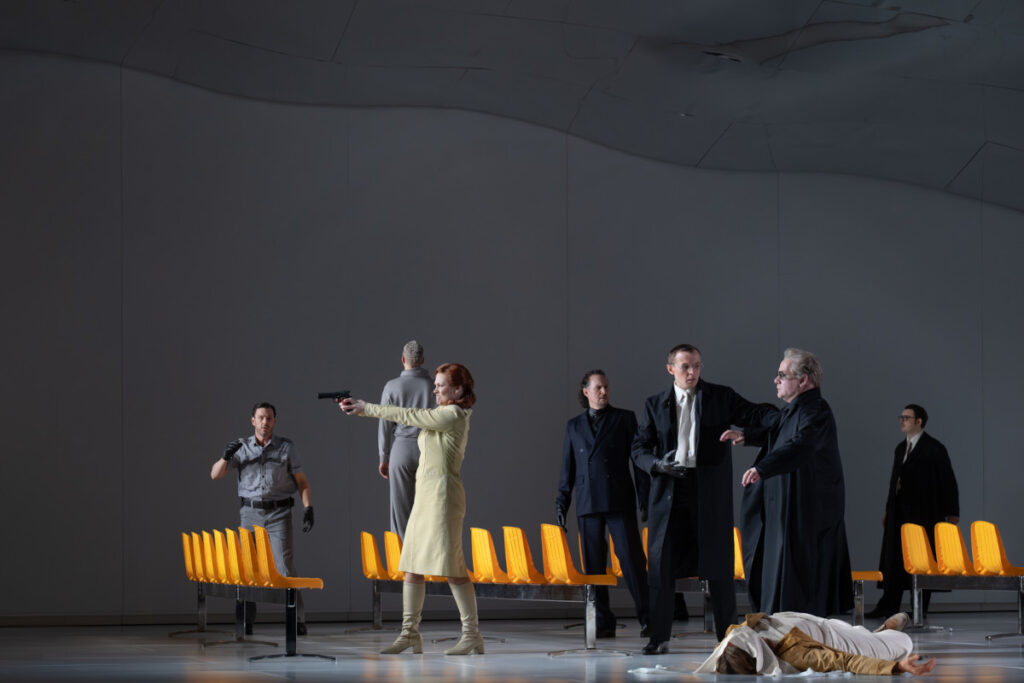
As the opera’s only personally named character, Camille Schnoor projects a tone of penetrating ardour, sometimes quite open and direct, but ultimately achieving a Straussian radiance. Ric Furman is softer of voice, perhaps aiming at a Parsifal-like naivete or otherworldliness, and is occasionally strained or is obscured by the orchestra. But in general, the lyrical thrust of his interpretation hints at the Stranger’s guilelessness. Damien Pass’s Gaoler sings with a more overt, heroic vigour, while Josef Wagner is a bold, forthright Ruler, if not especially fearsome. Paul McNamara is robust as the Blind Judge, leading the six other Judges who blend well in ensemble as the representatives of the law who are less understanding or compassionate than their sightless counterpart.
Robert Houssart, in conducting the Orchestre philharmonique de Strasbourg, doesn’t overindulge the characteristic lushness of Korngold’s score. Instead, they maintain a dynamic performance by attentively revealing its different layers in terms of timbre and volume, rather than through tempo or pace alone, eliciting an arresting fluidity and depth. The Chœur de l’Opéra national du Rhin make an equally vivid contribution.
If, on reflection, the opera doesn’t escape the impression of refracting the complex metaphysics of Parsifal through the comforting, simplifying gauze of a Hollywood epic, in the moment of this performance, the music and production here bring to bear on the work a certain emotional and aesthetic logic which makes one feel the sense of transformation at the end to be almost persuasive. It’s certainly a privilege to see this rare staging of the opera.
Curtis Rogers
Das Wunder der Heliane
Composer: Erich Wolfgang Korngold
Libretto: Hans Müller-Einigen after Hans Kaltneker
Cast and production staff:
Heliane – Camille Schnoor; The Ruler – Josef Wagner; The Stranger – Ric Furman; The Messenger – Kai Rüütel-Pajula; The Gaoler – Damien Pass; The Blind Judge – Paul McNamara; The Young Man – Massimo Frigato; The Six Judges – Thomas Chenhall, Glen Cunningham, Daniel Dropulja, Eduard Ferenczi Gurban, Michał Karski & Pierre Romainville; The Angel – Nicole van den Berg
Director – Jakob Peters-Messer; Set, lighting and video designer – Guido Petzold; Costume designer – Tanja Liebermann; Choreographer – Nicole van den Berg; Conductor – Robert Houssart; Chœur de l’Opéra national du Rhin and Orchestre philharmonique de Strasbourg
Opéra national du Rhin, Strasbourg, France, Saturday 24 January 2026
Top image: L’Étranger (Ric Furman), Héliane (Camille Schnoor), and La Messagère (Kai Rüütel-Pajula)
All photos © Klara Beck