We’ve been there before with protest music or music aiming to generate change. And music can prompt desired responses – environmental, social or political – including works like Haydn’s ‘Farewell’ symphony (an early example of industrial action) or Peter Maxwell Davies’ Farewell to Stromness conceived in 1980 to oppose plans for mining uranium ore in the Orkneys. More recently, there have been contemporary works addressing environmental issues such as Robert Kyr’s Earth Ritual (2022) or Rachel Portman’s The Water Diviner’s Tale (2020). Julia Wolfe’s oratorio unEarth is a further reminder of climate transformation and a campaign against those who abuse the natural world.
Her large-scale work (lasting some forty minutes) was first performed in New York in 2023 and was originally conceived with a spatial staging with singers moving around. Limited space at the Barbican merely allowed the moving images of Lucy Mackinnon’s video projections to be shown on a circular screen suspended over the stage. In addition, though not intentionally, there were the frantic movements of two busy percussionists moving hurriedly from one set of instruments to another. Squeezed onto the stage behind an expanded BBC Symphony Orchestra were two dozen men of the BBC Singers, the Finchley Children’s Music Group and National Youth Voices, all incisively directed by Martyn Brabbins.
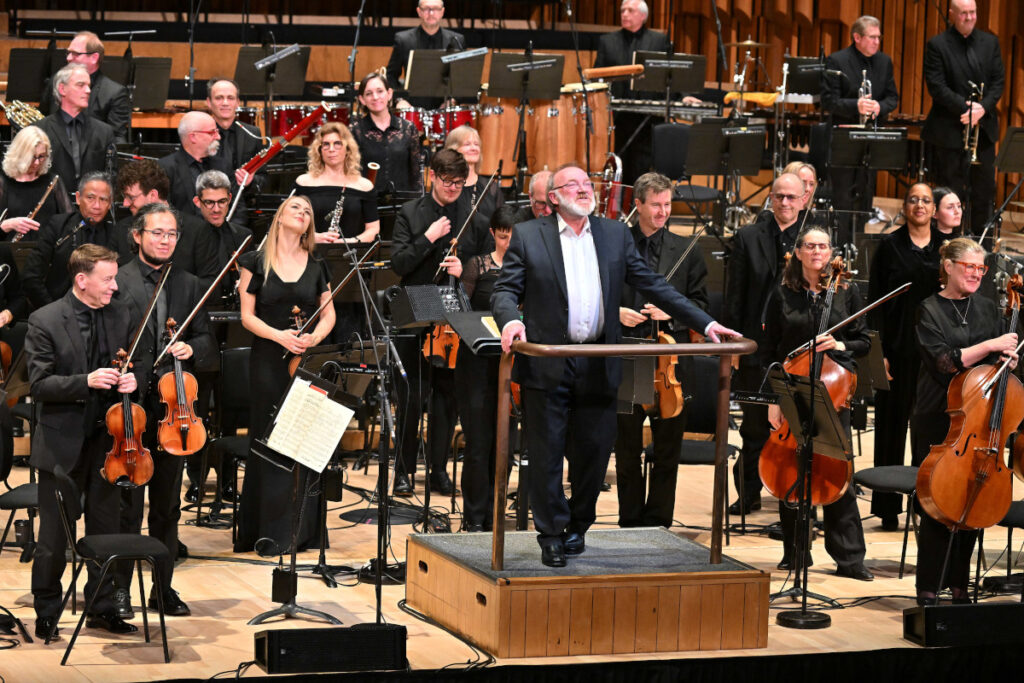
Adjacent to him was Danish soprano Else Torp whose text from Emily Dickinson’s Who robbed the woods? formed part of the work’s central movement entitled Forest, here begun by tenors and basses chanting different words for ‘tree’ in a multitude of languages supposedly to represent the interdependence within the forest ecosystem. Regrettably, these punched out words ultimately lost any musical interest despite the woodland visuals. Elsewhere, the work’s outer sections (both involving children’s voices), Flood and Fix It drew on words from the Bible (the Book of Genesis) and protest comments from teenagers such as ‘Hope requires action’ and ‘there’s no planet B’. The explicit messaging of nature’s despoilation felt very last century with the music failing to engage the ear in any meaningful way and prompting one disgruntled early leaver shouting to me ‘what a bloody awful waste of resources’.
Wolfe seems unable to resist writing for huge instrumental forces, yet within the extras including piano, electric organ, steel and bass guitars and drum kit, it was largely only the latter that made any impact within a score embedded in a cloud of writhing strings, pithy brass and woodwind shrieks. And if the work’s colourful turbulence pulsated with a minimalist energy, the whole could have belonged to numerous 20th century composers (not least John Adams) that bordered on pastiche. For all that, Brabbins secured a convincing if not compelling performance, with well-disciplined children’s and adult voices bringing periodic excitement to the barrage of sonic and visual effects. If only the setting of the texts in the third movement (‘deforestation’ and ‘regeneration’ etc) didn’t feel so ordinary, dressed with music that was largely unmemorable. We already know that climate change brings environmental destruction, so why not create a more impactful and less patronising text supported by music that fully uses the resources available.
Both Wolfe and Copland have been Pulitzer Prize winners: Wolfe for her oratorio Anthracite Fields in 2015 and Copland for his 1944 ballet Appalachian Spring conceived for thechoreographer Martha Grahamasan idealised portrait of rural life in 19th-century Pennsylvania. It was the latter that opened this Barbican concert where its ‘homegrown’, folk based tunes and infectious dance rhythms felt utterly sincere. With impressive attention to detail, Brabbins caught the music’s varied moods to perfection, tempo contrasts and contrasting dynamics were well-judged and amply realised the work’s poignancy and exhilaration. Woodwind cameos were very special and ‘Simple Gifts’ radiated optimism followed by touching send off.
This concert will be broadcast on BBC Radio 3 on 12 February at 7.30pm.
David Truslove
Aaron Copland: Appalachian Spring
Julia Wolfe: unEarth (UK premiere)
Else Torp – soprano; National Youth Voices; Finchley Children’s Music Group; BBC Singers; BBC Symphony Orchestra; Martyn Brabbins – Conductor; Anne Kauffman – Director; Lucy Mackinnon – Projection designer; Ben Stanton – Lighting; Produced by Bang on a Can
Barbican Hall, London 23 January 2026
All photos © Mark Allan