Although Lully’s operas are still not widely seen – certainly not outside of France, despite their fundamental part in the development of 17th century music drama – Atys (1676) fares better than most in stagings and recordings. It stands as good an example of his great series of tragédies lyriques as any of the others, with its fusion of classical myth, lyrical poetry, musical setting, and dance.
Angelin Preljocaj’s compellingly simple (but not simplistic) realisation of the opera gives a sleek, modern slant on its synthesis of the arts. In contemporary, though ultimately and essentially timeless costume, the drama plays out for the most part amidst a setting of black and white shades that is redolent of the sobriety of Classical tragedy by which the drama was inspired. That is intensified by having the characters shadowed by the members of Ballet Preljocaj, who mimic their actions and movements, which derive from Baroque theatrical gestures. The singers in turn tend to echo the dancers’ choreography in non-vocal passages and dance numbers, so that there is a perfect integration of directorial concept and balletic choreography, which faces down the criticism of those who say that drama and pace in such French Baroque operas are held up by the inclusion of numbers for dancing. Here it becomes a moot point as to whether the narrative generates dance or springs from it. If anything, the vivacity of Leonardo García-Alarcón’s conducting of the music suggests that the instinct to dance comes first.
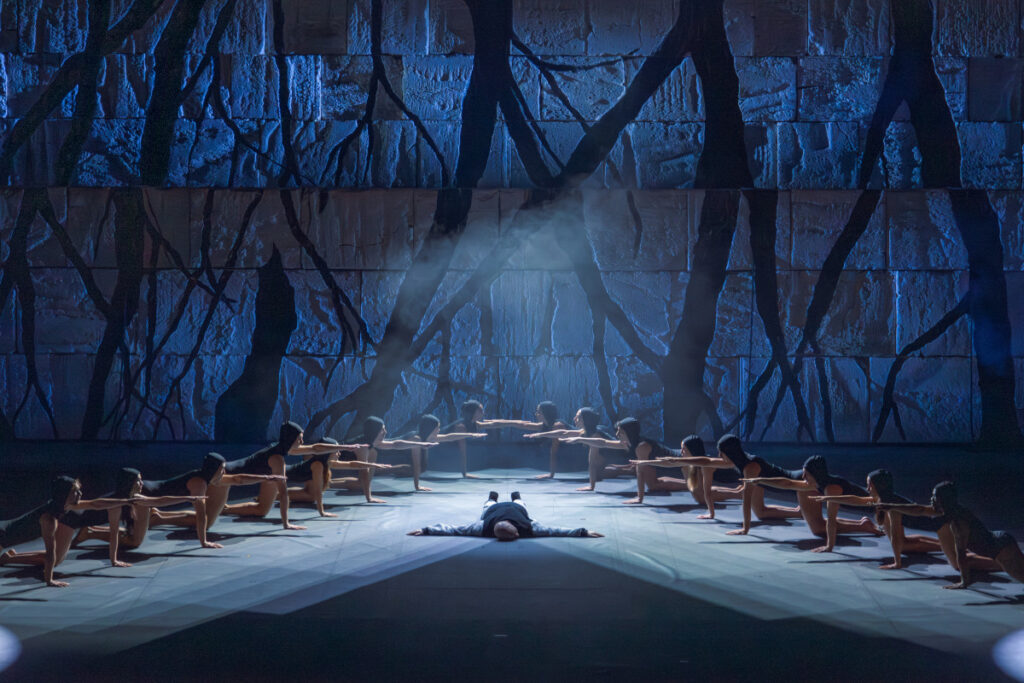
The sommeil or episode of Atys’s sleep in Act Three stands out all the more, coming as an intermediate climax and a turning point in the drama, where good and bad dreams present themselves. As he lies prostrate and motionless in the middle of the stage, the phantasms of his imagination emerge and fan out around him, depicting the conflicting forces that now assail him and will ultimately tear him and his beloved Sangriade tragically apart. Happy spirits of love on the one hand characterise their romance; on the other, vengeful spirits foreshadow the punishment that may be meted out for deceiving the gods since, having become a priest of the goddess Cybèle, she has fallen in love with him, but he hides from her the fact that he loves Sangriade, who in turn has been promised in marriage to Celenus.
The sundering of Atys’s mental and physical being is pre-empted by the dramatic opening up of the stone wall on stage which represents Cybèle’s temple (perhaps evoking Jerusalem’s Western or ‘Wailing’ Wall as a scene of lamentation) and by the shadows cast upon it which resemble cracks as much as they do the branches of the tree into which he will be transformed by Cybèle after he has attempted to stab himself. The skeletal form of that tree preserves a rather sombre and deathly image of Atys – almost as if he has been crucified on it – instead of a radiant or reposeful one.
The high tensions of the drama come out in some vivid performances from the soloists. In the title role Matthew Newlin’s tenor voice is coloured by the suffering of harbouring his love for Sangaride that he can’t disclose, grainier in timbre than the more typical translucent tone of a haute-contre. Giuseppina Bridelli maintains a suitable level-headed dignity as the goddess Cybèle, despite the hopeless of her love for him, though tinged with feeling and emotion rather than entirely haughty and distant. Ana Quintans’s Sangaride is delicate and restrained, compared with which Luigi De Donato is forceful as her father, the River Sangar, who has arranged for her to be married to Andreas Wolf’s colourfully effete Celenus. Some penetrating, haunting musical contributions come during the sommeil scene from Nicholas Scott in the eponymous part, and Attila Varga-Tóth’s Phantase.
Despite the prevailing dark hue of the production, García-Alarcón’s interpretation of the score with Cappella Mediterranea pulses with vibrant life and contrast. In term’s of Lully’s aesthetic, it’s arguably less historically accurate than, and a very different prospect from, the approach of Christophe Rousset and Les Talens Lyriques, for example, also encountered in Paris in the same week as this production, in the same composer’s Cadmus et Hermione. But it is characterised by the pace and colour of Baroque theatre more generally, at least how that is perceived today, and imparts its own creative authenticity to the realisation of this opera as a living work on stage, complementing Preljocaj’s masterly conjoining of choreography and drama.
Curtis Rogers
Atys
Composer: Jean-Baptiste Lully
Libretto: Philippe Quinault
Cast and production staff:
Atys – Matthew Newlin; Cybèle – Giuseppina Bridelli; Sangaride – Ana Quintans; Celenus / Time – Andreas Wolf; Idas / Phobétor / A fateful dream – Victor Sicard; Flore / Doris / Fountain Deity 1 – Mariana Flores; The River Sangar – Luigi De Donato; Sleep – Nicholas Scott; Mélisse / Fountain Deity 2 – Lore Binon; Morphée / River god – Valerio Contaldo; Phantase – Attila Varga-Tóth
Director and choreographer – Angelin Preljocaj; Set designer – Prune Nourry; Costume designer – Jeanne Vicérial; Ballet Preljocaj; Chœur de l’Opéra Royal; Cappella Mediterranea; Conductor – Leonardo García-Alarcón
Opéra Royal, Château de Versailles, France, Tuesday 27 January 2026
All photos © Baptiste Lacaze