For lovers of one particular television quiz, here’s your starter for ten. Who commissioned the following works: Debussy’s Le Martyre de Saint-Sébastien, Ravel’s Bolero and Stravinsky’s Perséphone? The same person who was orphaned at the age of eight, thereby inheriting a vast fortune, and was later rumoured to have kept a tiger cub in her Paris apartment. It was…the Ukrainian dancer and choreographer Ida Rubinstein.
Greek mythology is like the preternatural soap opera: warring families seeking power or revenge or both; half-sisters and half-brothers plus the products of incestuous relationships suddenly popping up to play their roles on the theatrical stage; the mysterious workings of fate replete with divine interventions (think: the whims of latter-day scriptwriters) intended to restore order from chaos. Persephone is part of the myth that explains the origin of the season called spring. She, the daughter of Zeus and Demeter, has been abducted by Pluto and brought to his realm of Hades. There she eats the seeds of a golden pomegranate and is required to stay in the underworld for four months of the year before she is allowed to rejoin her family. The libretto by André Gide, echoing a verse from St. John’s Gospel, ends with the words: If spring is to be reborn/The seed must die/Beneath the ground, to reappear/As a golden harvest in years to come.
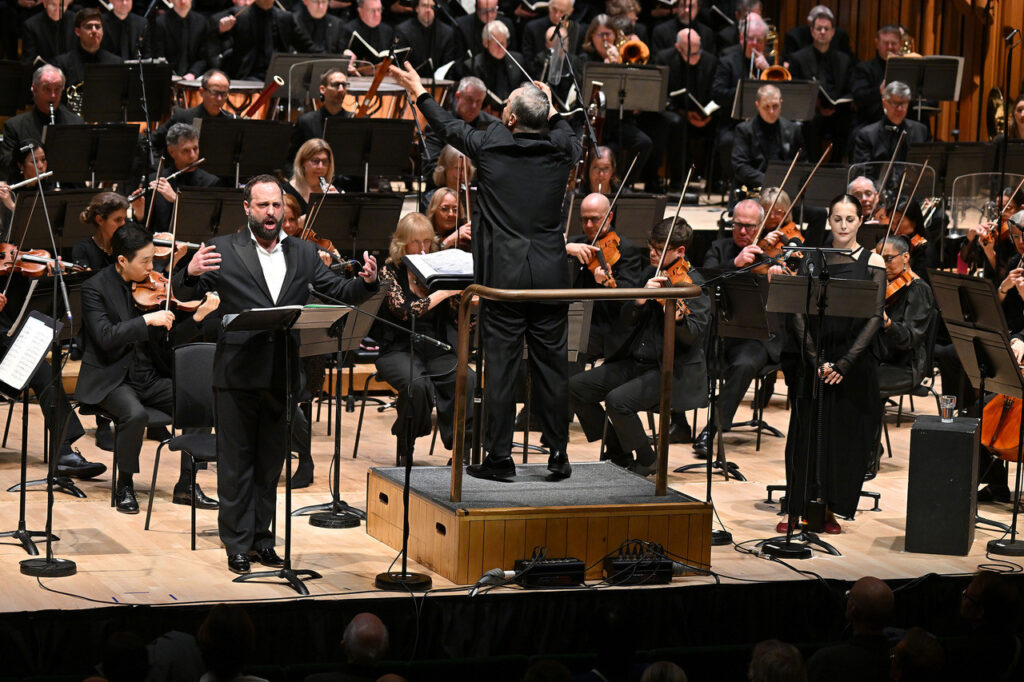
Described as a “mélodrame” for solo singers, chorus, dancers and orchestra, Stravinsky’s Perséphone is part of his preoccupation with juggling different genres in his neoclassical period following the First World War. It continues his deep interest in Greek mythology which led to the earlier Apollon Musagète and Oedipus Rex. At just under an hour, it is Stravinsky’s longest work before his 1951 opera, The Rake’s Progress. Perséphone was first performed in 1934, the same year that it was premiered in the UK by the BBC Symphony Orchestra. Here, in this outing, it was again that orchestra plus additional choral forces under Sakari Oramo which lifted the veil on what Elliott Carter classified as “the humanistic rite of spring”.
Why does it feature so rarely in concert programming? It has nothing of Le Sacre’s sensationalism or the brash grandeur of Oedipus Rex, and its vocal, choral and orchestral palette frequently cast in pastel colours is seen as too refined for popular appeal, amounting to a kind of musical Impressionism. For all the notable care lavished on this performance by Oramo, one important dimension was missing. There were no dancers. Adding that element would have proved well-nigh impossible, for the Barbican stage was packed with a very large orchestra including two harps, bass drum, keyboard percussion and tuba, not to mention the serried ranks of the BBC Symphony Chorus and two children’s choirs. However, though Oramo did as much as he could to allow the neoclassical textures to breathe, the overall effect was one of stasis, of a body being constrained from allowing its full potential for expression.
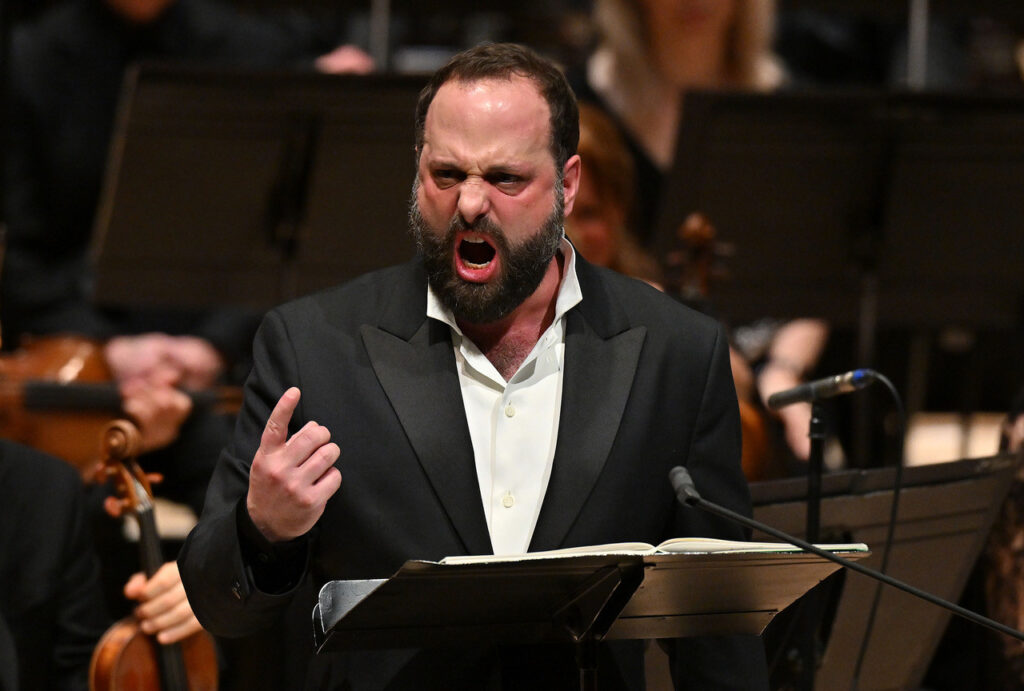
The main vocal weight comes in the figure of Eumolpus, a priest-like character who introduces the various scenes that make up the three parts detailing Persephone’s ravishment, her descent into the underworld and her rebirth. This was given to the American tenor Peter Tantsits, whose very demonstrative body language was somewhat at odds with the long lyrical lines that Stravinsky wrote. Sadly, his voice did not sit well with me either. Grainy and deploying a wide vibrato, there was evidence of slight strain in the challenging tessitura that takes Eumolpus from the heroic heights to baritonal depths. More importantly, I struggled with his diction. This was in marked contrast to the native French voice of Amira Casar, cast in the narrative role of Persephone. However, even with modest amplification her speaking voice did not always carry sufficiently, and the sheer length of Gide’s lines meant that the delivery needed at times to be quite rapid. The cooperation between composer and librettist was not exactly a marriage made in heaven: Stravinsky railed against what he called Gide’s “caramel verses”, evident in phrases like “pétale ruisselant de liqueur” (= petals dripping with liqueur), and in turn Gide never forgave the composer’s tendency to bend syllables to his musical will rather than to verbal sense.
Much of the choral writing is in the hands of female voices, the ladies of the BBC Symphony Chorus conjuring up a Mendelssohnian delicacy and lightness for their very first entry, “Reste avec nous, princesse Perséphone”, as well as at the start of the Deuxième Partie where they sing of the drowsily slumbering Persephone, pressing to her breast the narcissus whose scent has moved her heart to pity. It is this passion, or more correctly compassion, for the lost souls in Hades, viewed by Persephone as “a people without hope”, that informs her willingness to spend time in the underworld. The chorus maintained a beautifully sustained legato for lines such as “Si tu contemplais le calice du narcisse” (= Wert thou now to gaze upon the bloom of the narcissus), a radiance when they sang of hope being reborn in their rejoicing hearts, and an outpouring of longing at the point when, “Viens, Mercure!”, they invoke Mercury’s powers to dispel all the darkness. The male voices did not always match their female counterparts in terms of incisiveness, though their fortissimo cry of “Pluton!” was unquestionably dramatic, as was the exultant voicing of “Printemps!” by all the choral forces in the Troisième Partie.
Time and time again there were opportunities to savour the mastery of instrumental writing which Stravinsky displays. At the start of the second part I was reminded of D.H. Lawrence’s magnificent poem Bavarian Gentians with its references to Persephone entering the underworld in lines such as “darkening the daytime torchlike with the smoking blueness of Pluto’s gloom”. Stravinsky’s use of dark colouring in the bassoons, clarinets and bass clarinet as well as a mournful oboe to accompany a dirge-like procession of lower strings and deeper woodwind is one remarkable instance of his craft. As in the extensive use of silvery flutes, the celebratory solo trombone in the opening of the third part, and the role of solo violin and the two harps while Eumolpus and the choirs conclude the story of Persephone’s embracing of the seasons. The BBC Symphony Orchestra under Oramo’s taut rhythmic control excelled in all the instrumental colouring.
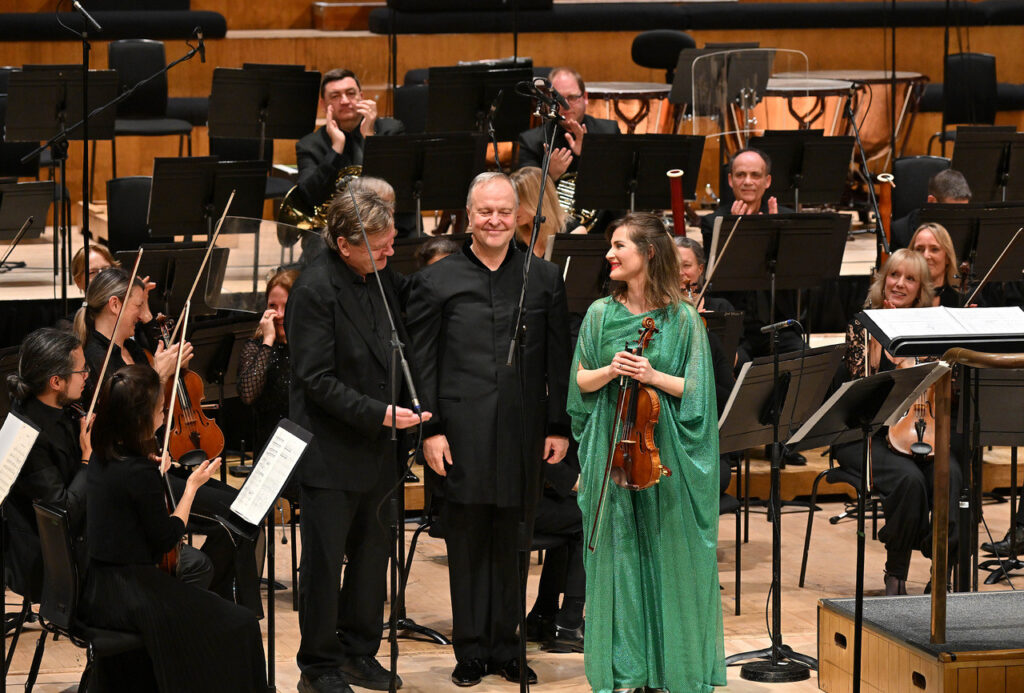
There was quite a meaty hors d’ouevre (or should that be tasty smörgåsbord morsels?) in the form of Magnus Lindberg’s First Violin Concerto, given in the presence of the composer by its dedicatee, Lisa Batiashvili. Written for a modest Mozartian accompaniment grounded on just two double basses, this is music that is constantly on the move and, moreover, it always seems to be heading in a designated direction. I appreciated all the Sibelian sonorities in the first of the three linked movements, the repeated whooping of the horns often required to play in a very high register and the way in which the upper strings trembled, shook and shivered. Above all, it was the security of Batiashvili’s playing, her amazingly powerful bowing and her energetic interplay with other sections of the orchestra which contributed to a most impressive performance. Not least in the ear-teasing compendium of detail was her exploration of a grey interior in the second movement, where the solo violin constantly seems to be seeking answers within an all-encompassing gloom. In her shimmering, emerald-green gown Batiashvili was like Persephone herself, the embodiment of eternal spring.
Alexander Hall
Lindberg and Stravinsky
Magnus Lindberg – Violin Concerto No. 1; Stravinsky – Perséphone
Lisa Batiashvili (violin); Amita Casar (narrator); Peter Tantsits (tenor); BBC Symphony Chorus; Choir of Grey Coat Hospital School; Schola Cantorum of the Cardinal Vaughan Memorial School; BBC Symphony Orchestra, Sakari Oramo (conductor)
(Stravinsky’s work sung in French with English surtitles)
Barbican Centre, London, 6 February 2026
Top image: BBC Symphony Orchestra, Choruses and Sakari Oramo
All photos © Mark Allan