If Agostino Steffani is remembered at all, it is probably for working at the Hanoverian court at the time when Handel was also briefly employed there, in 1710-11, after his long tour in Italy, and who was inspired by the older Italian musician’s chamber duets, which prompted his own set. Steffani was an experienced composer of opera by that time, having written several such works at Hanover, as well as in other centres, while also pursuing a career as a diplomat. Amor vien dal destino was written in 1694, though it is not clear if it was performed at that time; the first documented staging is at Düsseldorf in 1709. His coincidental connection with Frankfurt is that he died there, on his way to Italy in 1728, and was buried in the Cathedral. It’s appropriate then that Oper Frankfurt should give this rare outing of one of his operas, which takes an episode from the Aeneid for its narrative.
The destiny referred to in the title is that, although the Latian princess Lavinia is engaged by her father Latinus to prince Turnus, it is revealed by Latinus’s father, the river god Fausto, that Lavinia’s destiny is in fact to be married to Aeneas, and so produce the Roman nation. As a work which deals with the proper constitution of power and dynastic succession, it’s essentially an opera seria, the form that came to dominate the stage by the beginning of the 18th century. However, in this period just before the wholesale Arcadian reform of opera by the likes of Apostolo Zeno and Metastasio, Steffani’s work also preserves various elements of Venetian comedy as found in Cavalli’s operas for instance, particularly in the servant roles, and the figure of the nurse in drag (Nicea here). But, intriguingly, humour also pervades the opera’s most ostensibly serious dimension, the Prologue among the deities, and Jupiter and Venus specifically, who discuss what Aeneas’s destiny is to be, after the end of the Trojan War. Such a Prologue, and some numbers influenced by dance genres, recall the Lullian tragédies lyriques of Louis XIV’s court. The appearance to Lavinia in a dream of a man with whom she will find happiness and fulfilment is also treated with some degree of levity by Nicea, and not the portentousness with which, say, Senta’s premonitions in Der fliegende Holländer set the tone in Wagner’s much later opera.
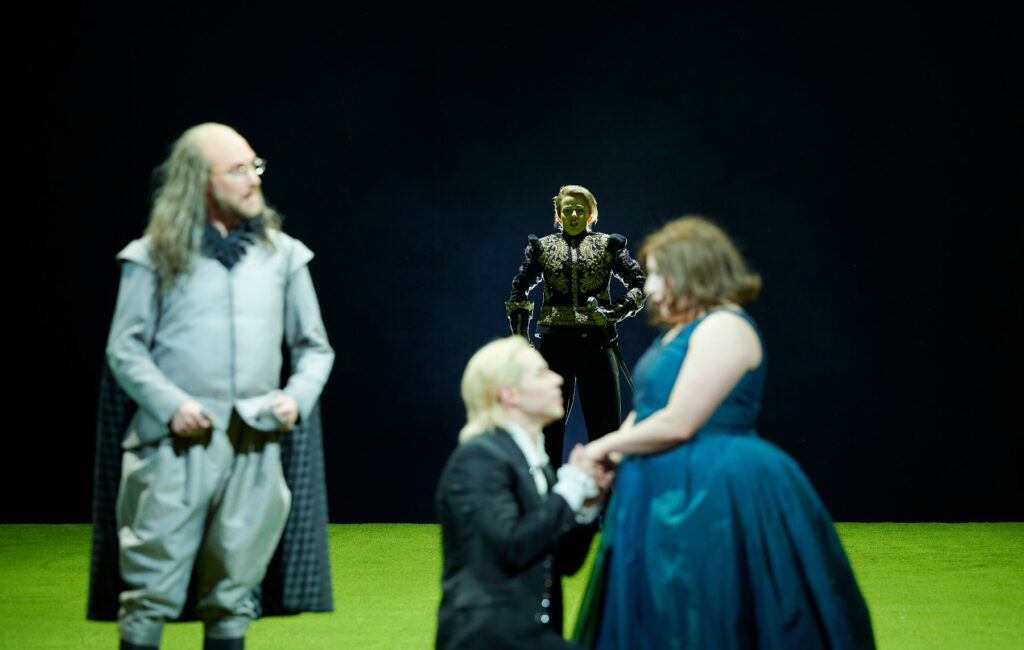
R.B. Schlather’s production pares the work back to its Baroque theatrical essentials. He takes a risk in letting the narrative – upwards of three hours in length – be told by the characters alone on a plain green set which rises from the front of the stage to imply a sense of destiny projecting into the distance. The singers’ energetic performances pay off by creating a vivid set of interpersonal relationships, clad in adapted Baroque costume. Jupiter’s long curly wig, for example, is surely meant to invoke Louis XIV, while Venus’s hooped skirt also parodies the extravagant fashions of early 18th century courts, where absolutist power held sway over populations at that time, just as these deities whimsically decide the fate of mortals here.
Václav Luks’s robust conducting of the score takes it more seriously, imparting vigorous rhythms and a determined direction throughout. The stately Overture could almost be Handelian. Although the sequence of vocal numbers conforms to the same pattern of earlier operas in the 17th century – usually relatively short and featuring strophic or other forms as much as the ca capo aria, and a generous array of duets and trios among solo pieces – the flow of the interpretation here is not particularly hurried. An extensive continuo section of harpsichord and organ, lute, theorbo, Baroque guitar, and harp provide a battery of instrumental colour, as do the small bells and chalumeaux. The latter conjure the unworldly presence of Fausto when he appears, as well as mimicking the timbre of trumpets for the triumphant fanfare which precedes Lavinia and Aeneas’s wedding.
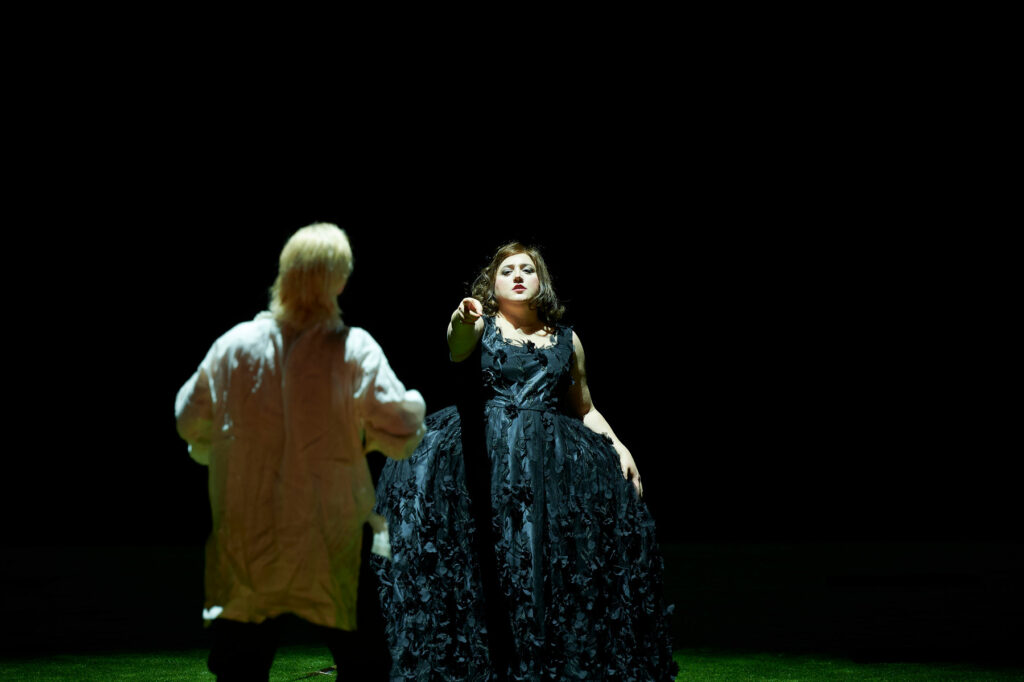
As the drama’s principal character, Margherita Maria Sala’s Lavinia is animated and voluble in her singing, but with clear, commanding focus so as to give a heart-rending account of her aria that follows after the interval, in which she contemplates suicide. She isn’t given to the same flamboyance as her sister, Giuturna, in Daniela Zib’s account, who feels drawn to her fiancé Turnus instead, and pretends to be Lavinia in order to pique his interest. Zib exudes a similar coquetry as Venus. In the trouser role of Turnus, Karolina Makuła cultivates some volatile and vivid singing, sometimes raw, in the sort of vocal acrobatics and decorations usually expected of the prima donna, as the character vents his rage against Lavinia’s reneging on their marriage. Aeneas sweeps into the narrative fairly late on, and remains a figure of some mystery in Michael Porter’s musically heroic but slightly aloof interpretation. Despite having to contend with the diplomatic awkwardness of his daughter’s rejection of Turnus, Thomas Faulkner’s bass is steadfast and dark-toned but also agile in the part of king Latinus, providing a centre of stability amidst the hectic activity of the drama.
Theo Lebow’s nurse, Nicea, is all the better for not overdoing the camp attitude, either in singing or acting, and letting the ribald humour speak for itself, though with a knowing delivery. His performance also ensures that comedy elsewhere is not obscured. Pete Thanapat demonstrates an engaging Italianate flair in the role of Aeneas’s servant Corebo, both in the lustre of his singing and the charisma of his acting, as he flirts with Nicea. But he rightly adopts a withdrawn, veiled timbre in the role of the god Fausto. Constantin Zimmermann brings a fluid expressivity in the parts of Coralto (Turnus’s captain) and Jupiter, the fact that the latter role is set for countertenor also suggesting a degree of satire that Steffani meant to direct against authority, given that the chief of the gods might have been expected to be set as a bass. In short, the whole project proves to be an engaging and witty take on what is otherwise an episode of some gravity from classical myth.
Curtis Rogers
Amor vien dal destino
Composer: Agostino Steffani
Libretto: Ortensio Mauro after Virgil
Cast and production staff:
Lavinia – Margherita Maria Sala; Enea – Michael Porter; Turno – Karolina Makuła; Giuturna / Venere – Daniela Zib; Latino – Thomas Faulkner; Giove / Coralto – Constantin Zimmermann; Corebo / Fauno – Pete Thanapat; Nicea – Theo Lebow; Double Giuturna / Venere – Julia Alsdorf
Director – R.B. Schlather; Set designer – Anna-Sofia Kirsch; Costume designer – Katrin Lea Tag; Lighting designer – Jan Hartmann; Dramaturg – Mareike Wink; Frankfurt Opern and Museumsorchester; Conductor – Václav Luks
Oper Frankfurt, Germany, Thursday 5 February 2026
Top image: Constantin Zimmermann (Coralto), Karolina Makuła (Turno; kniend) und Daniela Zib (Giuturna)
All photos © Matthias Baus