A Fancy by John Dowland, played on the lute alone, followed by the Prelude from Berg’s Three Pieces for Orchestra Opus 6, set the scene for this tale of lust, guilt, and violence set in 15th-century Venice. Even if Dowland is not known for any connection with that city-state, nor did he live as early as that, his piece nevertheless conjures up the aura of the Renaissance, and of course, the mood of introversion and melancholy for which he is famous, as well as being an apt acknowledgment of the composer in the 400th anniversary year of his death. It conveys the delicate, vulnerable frame of mind into which the traumatised Violanta has retreated, following the rape of her sister Nerina by a prince of Naples, Alfonso, and her suicide in shame. Despite the comparatively more conventional, extroverted late Romantic character of Korngold’s score (premiered in 1916, just after Berg’s work was written, though not performed) Dowland’s introspection and the unsettled, swirling strains of the Berg plunge us into Violanta’s troubled but otherwise silent, inward state. David Hermann’s taut and utterly compelling production probes that further, turning this interpretation into a superbly integrated music-psycho drama.
That state is indicated by her standing transfixed on a simple round dais, encircled only by a ring above and focusing attention on her alone, even as other characters come and go amidst the darkness around her – figures in purple military suits and boots who suggest an authoritarian social setting. Only the Venetian carnival lures Violanta out of her psychological distraction. But the revellers in masks and tall conical hats – evidently inspired by Tiepolo’s depictions of the carnival – and with their long fingernails are decidedly sinister demons, seemingly taunting her peace of mind as much as does her grief over her sister. Hermann’s real coup de théâtre, however, is the helix of rotating chambers which thrusts upwards from below the stage, the metaphor for the psychoanalytical journey Violanta undertakes as she proceeds through those revolving chambers, prompted by Alfonso’s appearance, and she confronts the mental demons which assail her.
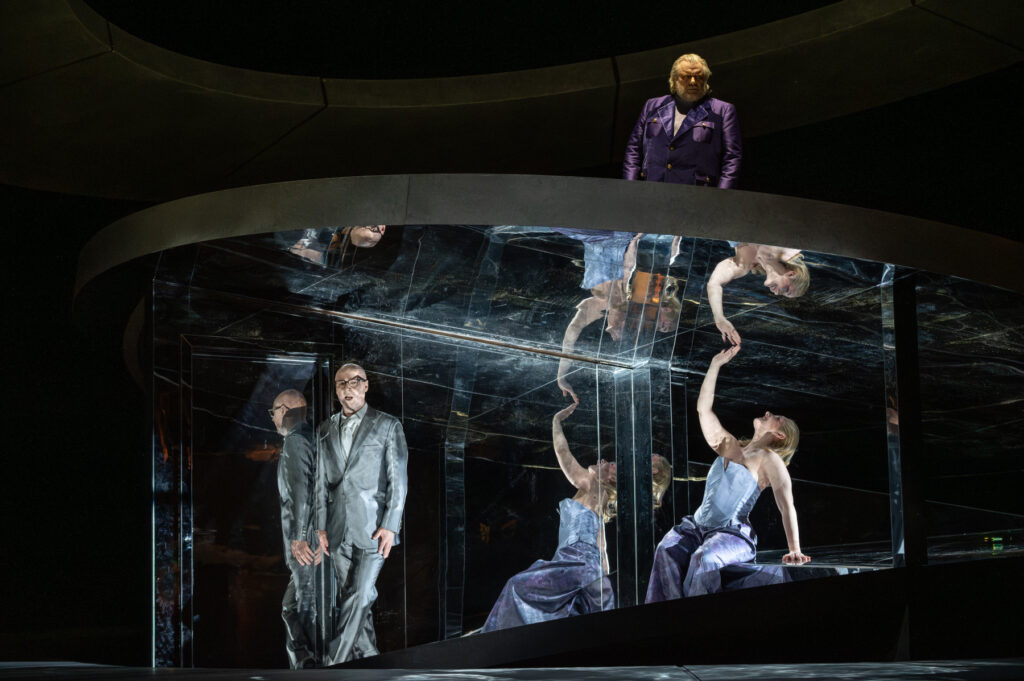
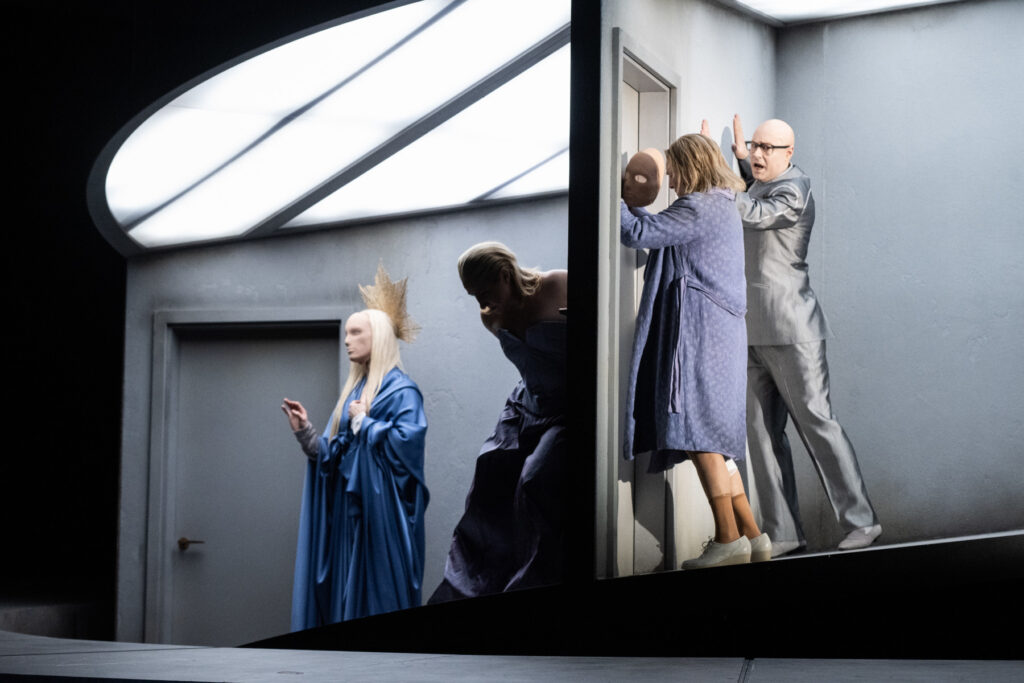
There she encounters a sequence of mannequins who are unmasked and come half to life, representing her dead sister; an older woman – perhaps her older self or, one is tempted to think, the mother of Alfonso, referred to by him at that point as having died in childbirth when he was born, such a loss being a possible explanation for his merciless, Don Juan-like exploitation of women; and a rather androgynous-looking Virgin Mary, who exposes a group of breasts or other reproductive organs on their torso, like some peculiar pagan god of fertility, and indicative of a hang-up by Violanta about religion and the ethics of sexual reproduction. Finally, a naked crowd – perhaps the carnival revellers stripped down – appears in the last room and, although the production puts us firmly in the realm of early 20th-century Viennese psychoanalysis, a compelling connection is implied with the Venetian setting of the original, that place where hedonistic pleasure and excess jostle with decay and death.
Not only does the grim recalling of figures from Violanta’s past allude to Paul’s obsessive hoarding of his dead partner’s relics in Korngold’s best-known opera, Die tote Stadt, the sequence of chambers undoubtedly also makes more than a nod to Bartók’s Duke Bluebeard’s Castle. Unlike the latter, Hermann’s production makes Korngold’s opera a modern tale of redemption. Whereas Violanta dies in the original scenario – in an arrangement similar to Gilda in relation to the Duke of Mantua in Rigoletto, having succumbed to Alfonso’s seductive nature and decides to sacrifice herself to the dagger which she had arranged for her husband Simone to wield against Alfonso at the time she would signal – here she doesn’t become yet another female victim of male desire but survives the attack by Simone. As the therapist which Hermann makes him, Alfonso marks off the matter as a psychological case study successfully completed, so that Violanta can return to the everyday world as a healed, whole person.
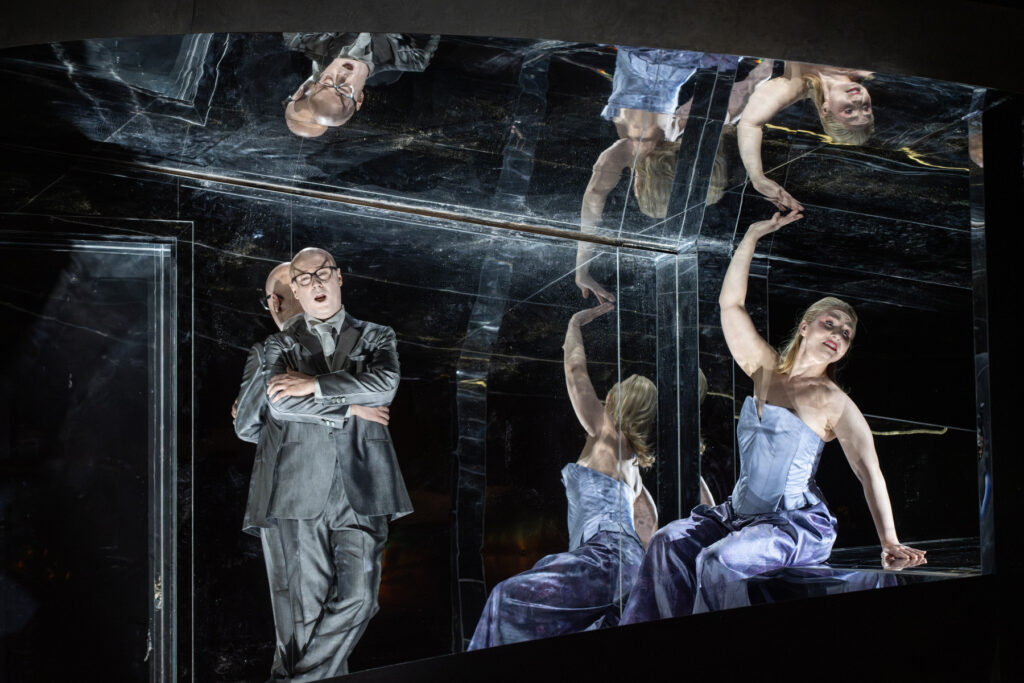
In terms of Hermann’s interpretation, that’s a coherent and logical outcome. But in those of the original libretto, it seems a pity that Alfonso’s own character development is not explored, since the text suggests that, in their long Tristan-esque dialogue, he and Violanta reach some sort of passionate accord despite the aggravated, mistrustful nature of their relationship up to that point. Alfonso’s own history, and possible redemption, are equally complex and intrinsic dimension to the work. But that is plausible material for a whole other, alternative production that could be just as intriguing, and this production clearly benefits from its razor-sharp focus on Violanta’s case, rather than digressing into that of Alfonso’s. And it’s also a mark of Hermann’s achievement here in revealing the potential of this short and little-known work which should be taken seriously by far more directors and opera companies.
The score is more than merely technically accomplished, as a sonic network which astutely signals the shifting thoughts and actions of the characters, of which any composer in the period up to the First World War could have been proud. That it was composed by a seventeen-year-old is astonishing, and its bristling welter of motifs, fragments, and instrumental sonorities does more credit to the drama than the more saccharine and opulent, but less pliant, style that Korngold adopted later in his output. As a one-act opera of barely 90 minutes in length, it can take an honourable place alongside Salome and Elektra. Sir Donald Runnicles’s subtle and fluid way with the score brings out the best of that teeming interplay of musical elements, particularly the kaleidoscope of timbres and interjections from the various instruments, which become a fundamental facet of the score’s structure and development here. The orchestra’s beginning with Berg’s Prelude clearly helps to set that up.
Despite Violanta’s troubled disposition for much of the drama, Laura Wilde gives a performance of clear-sighted determination, that soars confidently over the dense accompaniment, even in more reticent vocal passages, hinting at the character’s reserve of strength. It’s Ólafur Sigurdarson as her emotionally distant husband, Simone, who achieves a fine balance of uneasiness with a studied dark veneer in his voice. Mihails Culpajevs sounds a touch strained on Alfonso’s entry, where the Neapolitan prince announces himself with a florid vocal display, somewhat like the Italian Singer of Der Rosenkavalier, and so more Italianate lyrical charm would be more apposite. But he settles down into a more ardent and sustained account of his often strenuous music which, again, is somewhat at odds with the detached, disinterested interpretation of the role in this production. Other soloists and the Deutsche Oper Chorus give a vivid and even almost humorous sense of the busy comings and goings in the first part of the opera, before the central drama of Violanta’s coming to terms with her past plays out.
That reservation about the characterisation of Alfonso aside, the fusion of the opera’s libretto and music as mapped out in this staging makes it one of the most gripping productions I’ve seen for some time.
Curtis Rogers
Violanta
Composer: Erich Wolfgang Korngold
Libretto: Hans Müller-Einigen
Prologue: Dowland: A Fancy, P5; Berg: Three Pieces for Orchestra, Opus 6 – Prelude
Cast and production staff:
Simone Trovai – Ólafur Sigurdarson; Violanta – Laura Wilde; Alfonso – Mihails Culpajevs; Giovanni Bracca – Kangyoon Shine Lee; Bice – Lilit Davtyan; Barbara – Stephanie Wake-Edwards; Matteo – Andrei Danilov; Maids – Maria Vasilevskaya & Lucy Baker; Soldiers – Michael Dimovski & Paul Minhyung Roh
Director – David Hermann; Set and video designer – Jo Schramm; Costume designer – Sybille Wallum; Lighting designer – Ulrich Niepel; Dramaturg – Jörg Königsdorf; Opernballett der Deutschen Oper Berlin; Chor und Orchestra der Deutschen Oper Berlin; Lute – Pedro Alcàcer; Conductor – Sir Donald Runnicles
Deutsche Oper Berlin, Germany, Friday 6 February 2026
All photos © Marcus Lieberenz