The London Philharmonic Orchestra’s brief Phoenix Lands series of concerts looks at music from the period after the First World War when empires had crumbled and independent nations were being born on the European continent. If there was surely something demotic and earthbound about the textual background to the music here (even in Bartók’s pantomime ballet The Wooden Prince) this appeared in contrast to the sounds we heard which often snapped at the heels of chromatic romanticism, not least in those subtle hints of Wagner and Richard Strauss.
Two pieces by Vítězslava Kaprálová appeared in the first half of the concert (with Edward Gardner rescheduling her song ‘Waving Farewell’ (Sbohem a šáteček) from the advertised program where it was to have come immediately before the Bartók) showed a distinct sense of the loss from her early death from typhoid fever aged just 25. Kaprálová’s works actually sit much closer to the Second World War (the Rustic Suite dating from 1937) but the musical identity, of the folk music from Moravia, sounds just as clear as in Bartók’s The Wooden Prince which dates from 1917.
Rustic Suite may in fact owe more to the sound world of Stravinsky’s Petruschka in parts of it but its three movements – Moderato, Andante and Allegro – are emblematic of the harmony we sometimes hear in the nationalist music of Janáček. Moderato was perhaps the highlight here, music which evolved from a talented and sure composer’s hand; one who knew how to make the strings sing and the woodwind sound so evocative. But elsewhere (notably in the first movement) there was a gorgeous clarinet solo and luminous brass to frame music that obviously felt it was going somewhere.
Edward Gardner, in a short exploratory talk before the concert, spoke of his love for the Kaprálová song ‘Waving Farewell’ and its status as a near masterpiece: I’m not sure I felt quite the same. Vitězslav Nezval’s text for the song speaks of farewell in various guises – of ships sailing from the harbour, of birds migrating and of lovers sharing memories – and yet the song itself is framed from the point of view of the soprano sharing these with someone else. Juliana Grigoryan was pure of tone, even slightly erotic in some of her vocal gestures, yet the sheer intimacy she conveyed at times felt out of the kilter with the shared dynamics that were conveyed in the text.
Karol Szymanowski’s Stabat Mater, on the other hand, was given a magnificent performance, one that felt completely inside this composer’s strange yet febrile sound world. Stabat Mater isn’t in the familiar Latin but in Jozef Janowski’s demotic Polish version of it, and as a contrast to Szymanowski’s heaven-ascending yet firmly Polish folk-like music, it makes for an interesting combination. Palestrina may lurk beneath Szymanowski’s own setting of the text, but the gorgeous sonorities, with a whiff of incense burning around it, and of gentle opulence, are all of Szymanowski’s making. I think it is a work that sometimes jars with the senses – old and new worlds have a tendency to clash, and the sudden muscularity you hear (although this is rare) almost comes from nowhere.
It was certainly beautifully sung. I was taken with the bass, Kostas Smoriginas, who was alternately lyrical yet powerful. True, he could sound a little overwhelmed in the second movement where his bass was occluded by both the chorus and orchestra at different intervals – yet, the urgency of his singing, the depth he brought to it were compensation enough. Juliana Grigoryan was certainly opulent in tone from the start – and she has a pure, bright voice which had little difficulty rising above the stave and staying there. The mezzo Agnieszka Rehlis didn’t always have sufficient volume to my ears though the beauty of her register from top to bottom was even and secure. It’s certainly the case that Szymanowski’s tendency to focus on grief brought out the best from the trio of singers: in what can be a distinctly personal emotion, one felt that each of the soloists delved rather deeper into the wider meaning of the word and made the point of this being immersive rather than individual.
The London Philharmonic Choir – especially the tenors and basses – were superb as were the orchestra themselves (especially the cellos).
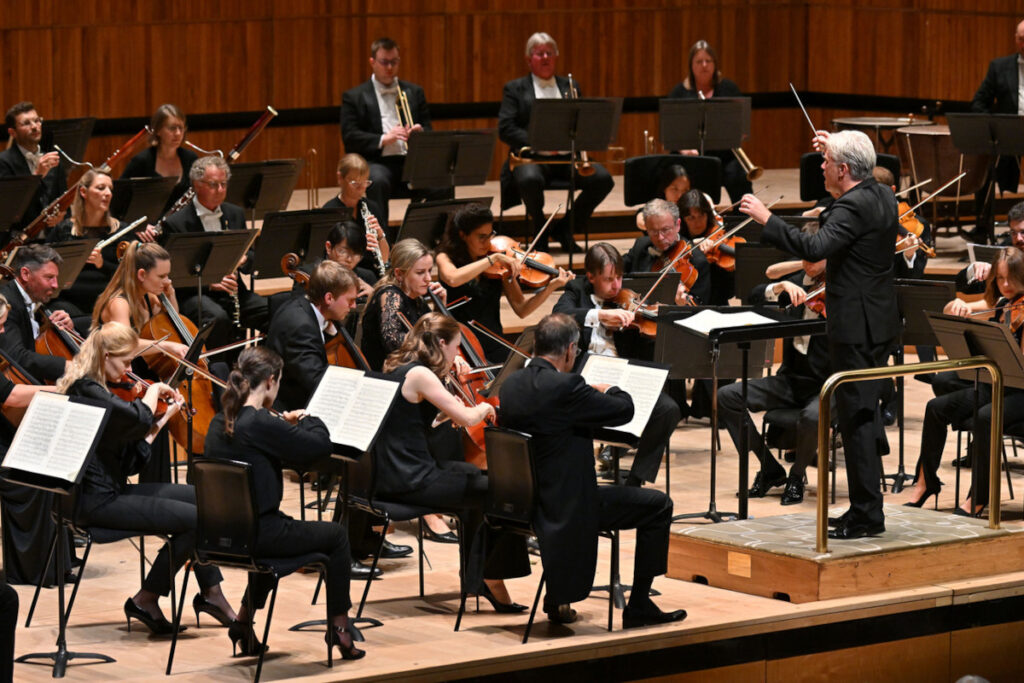
Bartók’s The Wooden Prince was given a ravishing performance. Considerably less impactful than this composer’s masterpiece The Miraculous Mandarin, The Wooden Prince is a less frenetic, less imaginative work but still packs a punch in a great performance of it. Gardner invested it here with pristine playing from the orchestra and tempi which were never less than exciting. If Stravinsky and the more Romantic Schoenberg shine through some of Bartók’s orchestral writing then so does Wagner (whose Das Rheingold is recalled at the work’s opening) and Richard Strauss, whose gift for orchestration is often replicated. The story, of a prince who cannot reach his princess, with the juxtaposition of his puppet, allowed Bartók to harmonise two distinct worlds in his music. It can be both grotesque and sardonic, but with a nervous sumptuousness that flows around this.
There was some incredibly virtuosic playing from the orchestra (especially in the violin writing) but more impressive still was a depth and richness to the playing which seemed to lift the score into a different dimension. If the ballet can sometimes seem high on humour, Gardner found plenty of space to give it an opulence that made the whole thing glitter.
Marc Bridle
Vítězslava Kaprálová – Rustic Suite, Waving Farewell; Karol Szymanowski – Stabat Mater; Bela Bartók – The Wooden Prince
Juliana Grigoryan (soprano); Agnieszka Rehlis (mezzo); Kostas Smoriginas (bass); London Philharmonic Choir; London Philharmonic Orchestra; Edward Gardner
Royal Festival Hall, London, 7 February 2026
All photos by Mark Allan