Although more associated with operas that really reside in the cracks of the repertoire, Opera Rara does investigate – or reconstruct – versions of better-known opera. Their release of the original 1857 version of Verdi’s Simon Boccanegra is one of those cases; and here we have Puccini’s La rondine. And while most revivals/reconstructions tend to concentrate on earlier versions, this 1921 version of La rondine lies at the end of three; the point here being that the 1921 score is the one Puccini wanted us to hear.
To elaborate: La rondine is usually heard in its standard 1917 edition (the first edition, premiered in Monte Carlo). But Puccini made two later versions, one premiered in 1919 in Palermo, then in 1921 came this version, which Puccini never saw in the theatre (it was premiered in 1924 in Rome)
But the two later versions are minus full scores. Historical reconstruction is required from the vocal score. Compared to the standard version, the plot moves in different directions in this last outing. The final version took Puccini back to his original ideas, so that at the end of the opera Ruggero discovers Magda’s past and rejects her; early on, Puccini dismissed this idea, and the standard ending is that Magda decides to leave Ruggero. In the final version, there is a more tragic idea that Magda wishes to continue the affair, but Ruggero ends the connection having discovered details of her past.
For a century now, this 1921 version has not been heard. The first version gets outings, beyond doubt: I think of Antonio Pappano around a year ago, with the London Symphony Orchestra again in the Barbican, and also of a memorable staged performance at Opera Holland Park, opening the 2017 season (with Elizabeth Llewelyn as Magda, and well conducted by Matthew Kofi Waldren).
It is not just the ending that differs: the dramatic arc is completely different in the 1921 version. The score is dedicated to Toscanini; “La rondine comes back home” was the inscription of the final score – Rizzi suggests his was his preferred version. Again, the second version has never been performed in its entirety (I mention this as an ensemble from the second act was encored in the second version – so, with chorus in the complete 1921 performance, and minus chorus in the encore; this climactic moment really is core Puccini, soaring melodies in the strings, voices at full tilt).
The musicological work here should be acknowledged first and foremost. Or, more accurately, musicological art: Martin Fitzpatick’s orchestrations are seamlessly integrated into Puccini’s compositional fabric (Fitzpatrick was also assistant conductor and chorus director), while Ditlev Rindom’s critical edition, published by Casa Ricordi, presents the work, finally, as a polished diamond.
What the changes mean in terms of their dramatic effect, and how the different “shape” of the opera emerges, is mainly in the hands of the conductor. Carlo Rizzi ensured enormous detail on a micro-level, while holding the larger processes firmly in his head, giving directionality and focus. The BBC Symphony Orchestra played at their best for him: no trace of scrawniness or harsh tone to the strings, for example. This larger-scale thought was even reflected in the placement of the interval: after Act 2, which meant a first part of around an hour and a quarter, and a second part (act 3 alone) of around 35 minutes. But it had to be: the atmosphere of the final act is very different: Lehár-laced operetta morphs into full-blown tragedy.
Another aspect of Puccini’s shape-shifting abilities is his referencing of other composes and trapping them in his web: most notable here, a quote from Richard Strauss’ Salome. Rizzi ensured that it was Puccini’s voice that was primary, always.
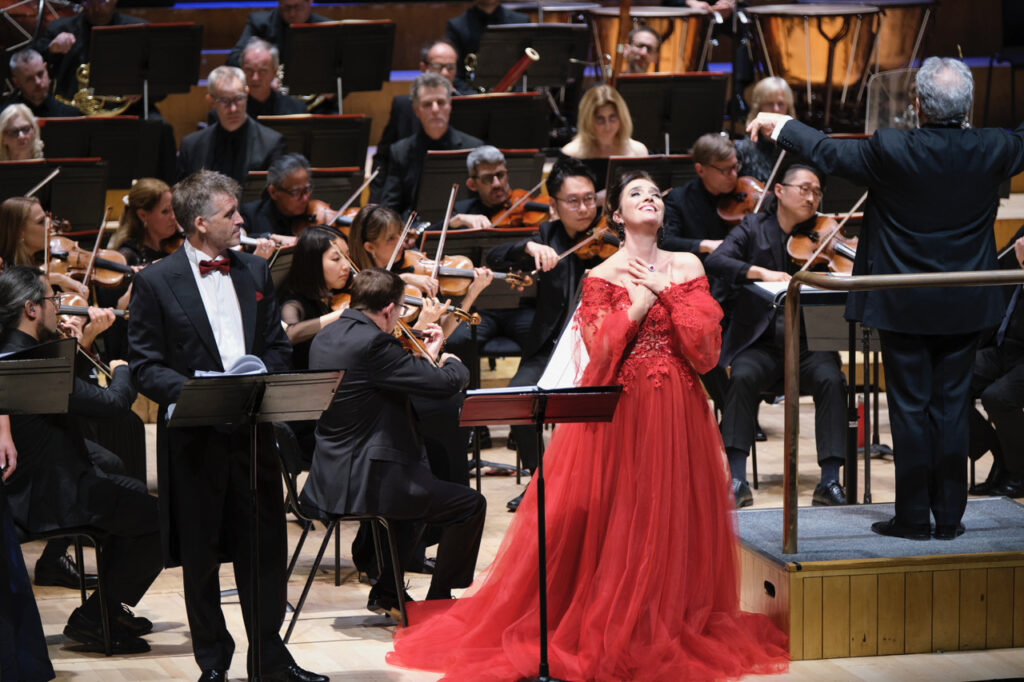
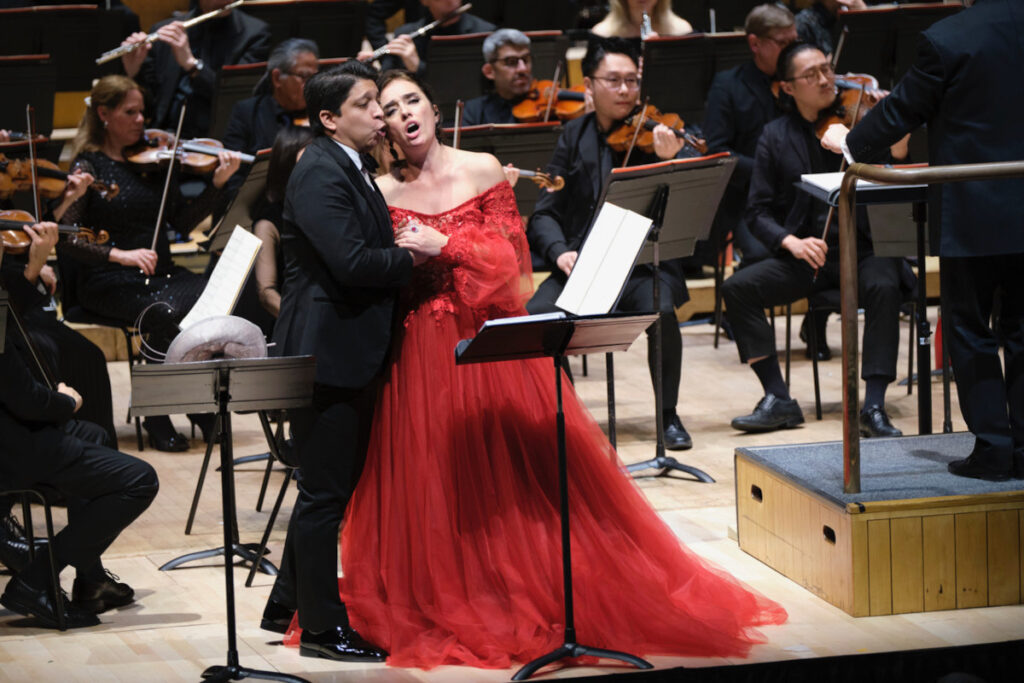
Soprano Ermonela Jaho is very associated with the role of Magda in the standard version – so there was a real sense of presenting something different, but simultaneously familiar. She is also no stranger to Opera Rara; try her recent two-disc, astonishing set of Donizetti Songs (with the present conductor, Carlo Rizzi, on piano). Her voice can produce the most breathtaking floated notes, and yet she has the power to be heard over Puccini’s orchestra going at forte and beyond. Most of all, we believe her character and Magda’s emotions: the end really is heart-wrenching, underpinned by Puccini’s darker scoring. Magda has to move from operetta, effectively, through to tragedy (a trajectory not a million miles from Violetta in Verdi Traviata, of course, but realised very differently by Puccini). Jaho has the full spectrum of emotion: and Puccini pretty much asks fo it all.
There is a complementary soprano part here, the role of Lisette, taken here by Ellie Neate. My experience of Neate is limited to a Janáček evening at the Wigmore Hall in November 2020 and as a Daughter of Akhnaten in Glass’s opera at English National Opera in 2022. Here, she shone, her voice light (yet never insubstantial), her dramatic ability perfect. Just occasionally, she was overpowered by the orchestra, but her light shone elsewhere almost as brightly as Jaho’s. She is definitely a name to watch.
Two complementary sopranos; and, to match, two complementary tenors, the lighter-voiced (and therefore more suited to his lighter connection with Lisette), Juan Francisco Gatell, confident as Prunier (the poet), while Iván Ayón-Rivas’ darker-hued, sometimes almost baritonal tenor offered a more appropriately passionate remit for Ruggero.
The other major role is Rambaldo, Magda’s patron and taken by the superb baritone Nicola Alaimo, whose disc of Donizetti songs in the same series – “Song Project” – already referenced is well-nigh beyond criticism. He was beyond criticism here, too, his voice full, rich, commanding.
Just as the voices for the two pairs of lovers were perfectly chosen, so those of the three grisettes, Jessica Robinson, Judith Lozaro-Rolong and Johanna Harries offered their own tapestry of colour, counterpointed by the gentlemen of Robert Lewis (Gobin), David Shipley (Périchaud) and William Thomas (Crébillon). The BBC Singers offered a powerful contribution as chorus.
But who was the star? La rondine herself, Jaho? Perhaps; the same goes for Alaimo, and indeed Rizzi in presenting the score in such a multi-coloured, detailed way with such understanding. But of course, the real star is Puccini, and that his 1921 version of rondine returned at last is a massive cause for celebration. Opera Rara’s recording, due Autumn 2026, is eagerly awaited.
Colin Clarke
La rondine
Composer: Giacomo Puccini
Libretto: Giuseppe Adami
Cast:
Magda de Civry – Ermonela Jaho; Ruggero Lastouc – Iván Ayón-Rivas; Rambaldo Fernandez – Nicola Alaimo; Lisette – Ellie Neate; Prunier – Juan Franciso Gatell; Yvette/Giorgetta/Fleury – Jessica Robinson; Bianca/Gabriella/Mariette – Judith Lozano Rolong; Suzy/Lolette/Rorò – Joanna Harries; Gobin – Robert Lewis; Périchaud – David Shipley; Crébillon/Il maggio domo – William Thomas
Opera Rara; BBC Singers; BBC Symphony Orchestra; Carlo Rizzi (conductor)
Barbican Centre, London, 5 December 2025
All photos © BBC/Opera Rara/Russell Duncan